 eSefarad Noticias del Mundo Sefaradi

TOURIST CIRCUIT / HISTORICAL VILLAGES, JEWISH HERITAGE AND JEWRY
(QUINTA DO CRESTELO (SEIA)- SANTA MARINHA – GOUVEIA-LINHARES DA BEIRA)
Start of Quinta do Crestelo.
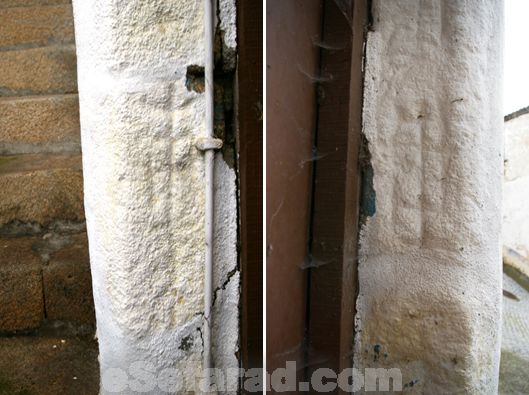
Visit the area of the former Castle of Seia. In the periphery, Rua (Street) 1º de Dezembro shows a home with a porch on the ground floor where he had established trade or workshop, jambs inscribed Cruciform type assigned to the Jews / New Christians. Your observation allows glimpse a Hanukia (nine-branched candelabrum) on the left and the opposite a Menorah (seven-branched candelabrum).
Walking through the neighborhood, you can see a few yards and alleys, entries cruciform in doorways and walls of houses where they have resided New Christians, the «Anussim» (forced conversion).
From the top of the hill where stands the parish church (XVIII century) one can see a vast panorama of the city and surrounding region with particular emphasis on the Serra da Estrela.
The journey continues towards Santa Marinha.
Santa Marinha village and was a county seat, in July 1150 received its first Charter, the second was given by D. Manuel I in Lisbon on May 15, 1514. The county was abolished in 1836. He was part of the Archdeaconry of Seia, which transferred from the Diocese of Coimbra for the Diocese of the Guard in 1882.
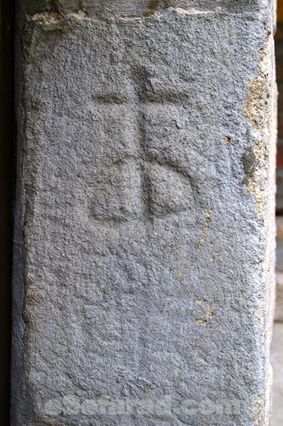
The presence of Jews and New Christians in this ancient medieval town is attested by the large number of entries cruciform and other brands registering their «Christianization.»
Here we have determined from remote times by the records auctioning of rights in rem in the first half of the fifteenth century by the Jewish Solomon Navarro. The geographical situation of Santa Marina and the abundance of water led to the establishment of activities related to the work of wool and its transformation, which lasts until today.
It is worth noting the central street of Santa Marina and adjacent streets where they can be seen some examples of architecture sixteenth and seventeenth century, showing cruciform architecture and typical home use attributed to Jews and New Christians to the ground floor where it was installed trade / workshop and first floor residence.
Also in the set houses addorsed to the Mother Church, dating from the XV-XVI century. Within the nearest Catholic weather is one or Hekhal Aron -ah-Kodesh-ah (cabinet Law)
In the urban setting of Santa Marinha can be observed several types of cruciform, particularly the Latin cross, decorated with a double interpretation – the Jewish and Catholic – Star of David and manors and stately houses, bridges and fountains root medieval.
Continuing the tour arrives at Gouveia, the Garden City, with great traditions of the Jewish presence that began with a small commune with about 50 Jews in the mid-fifteenth century. At the end of the century would be nearly 200. Here we find the Adida, Abenazo, Baruch Faravam, Navarro and Sacuto.
The commune of Gouveia has always been closely linked to the work of the wool, which has always characterized the city to this day.
After the date of expulsion of the Jews from Spain (1492), many of the refugees flocked to Gouveia (as to Covilha) with the sense of enhancing the work of the wool then practiced very rudimentary. The two villages (in season), with torrential streams and steep, offering hydraulic power required to move the wheels of the mills.
A few years later (1496) is built a synagogue whose record is clear on the stone found in 1967 in a house on New Street in full Gouveia. In this Jewish quarter of the city’s northern slope of the Serra da Estrela community was also well organized. Is to force the story that in the period between 1525 and 1530, fueled by hatred D. John III reached, making known this episode reported by Meyer Kayserling:
«In Gouveia was found in pieces an image of Mary, much beloved by the people. This sacrilege, assigned to the crypto-Jews of the city, led to the arrest of three of them, who were released after a few days. Mass enraged Jews accused of bribery . […] The inquiry against the crypto-Jews liberated was restarted at the insistence of the residents. False witnesses testifying against the accused and, as it proved later, due to slanderous accusations, died at the stake as heretics and defiling of holy images . »
A stone of ancient Synagogue of Gouveia can read: «The glory of this latter house shall be greater than the first; Says» Adonai «(Lord) of hosts: the house of our sanctification, our glory, and the ransomed of the Lord , come back and will return to Zion in joy” or says «Adonai» (Lord) ARMIES OF THE HOUSE OF OUR HOLINESS, OUR GLORY, AND RESCUED BY LORD will come back and will return to JOY IN ZION”
Translation of the Hebrew text of the stone synagogue Gouveia (1496) is exposed in the Museum of Sacred Art in the city. Was presumably the last synagogue built in Sepharad (Spain and Portugal) before the expulsion of the Jews by the Portuguese king D. Manuel I in 1496 and forced conversion that followed.
The journey leads visitors Linhares da Beira

It is one of the Portuguese historical villages. Had a Jewish quarter which can still be found. In a building near the center, duly noted, there is a Manueline house where worked formerly a Synagogue. This communicated with attached houses, of which there remain only the locations of the doors. Here you can see the most beautiful Manueline window of the village.
The Jewish quarter was composed by Straight Street (the procession) and Street Footbridge (Jewry). Even today you can notice it through the portals beveled scattered through the village and also through the Manueline windows. The new homes of Christians have, on their doorposts, crosses that protected the Inquisition. Even then, many lawsuits have been brought against families with names like Fernandes, Linhares, Nunes Rodrigues, Froes, Antunes.
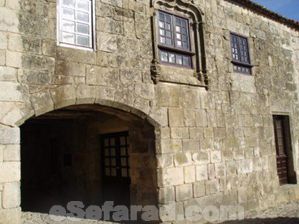
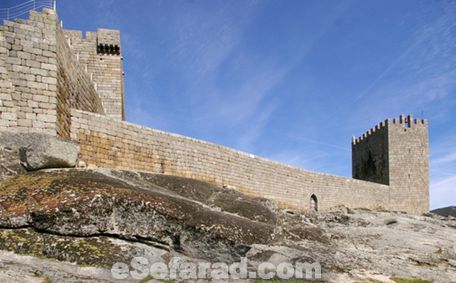
Linhares da Beira
1 – Castle
2 – Rua do Arco (Manueline façade)
3 – Misericordia Church
4 – Church of the Assumption
5 – Pillory
6 – Manueline window at Straight Street (the procession)
7 – Manueline window at Straight Street (the procession)
8 – Manueline window at Street Footbridge (the Jewish Quarter
José Levy Domingos
Portuguese researcher
I found this article quite interesting. During my last trip to Portugal, I captured a beautiful photograph of a Church door where 2 crosses on the upper part and 2 stars of David on the lower part were displayed.
Without much research it was obvious to me that there once existed positive inter-faith relations between Catholicism and Judaism in the region. Regretfully, I did not have time to visit the local historical archives to substantiate my assertion.