eSefarad Noticias del Mundo Sefaradi

Networks and Knowledge:
Synthesis and Innovation in the Muslim-Christian-Jewish Medieval Mediterranean
NEH Summer Institute for College and University Professors
July 2–July 27, 2012 • Barcelona (Spain)
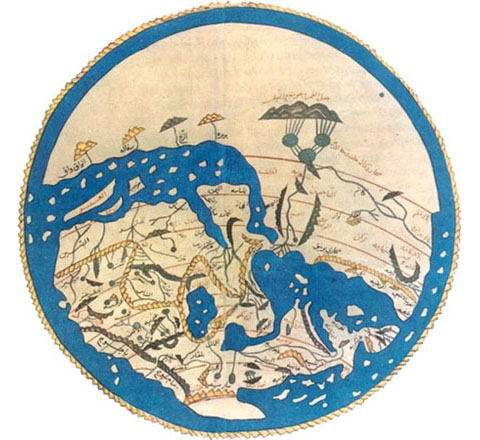 The Mediterranean Seminar announces the opening of applications for a four-week NEH Summer Institute to be held on in Barcelona, Spain, July 2-27, 2012.
This Institute, funded by the National Endowment for the Humanities, with the collaboration of the the Mediterranean Seminar/UCMRP and the support of the Institute for Humanities Research at the University of California Santa Cruz, will bring together 24 college and university faculty and graduate students for an intensive 4-week course, directed by Sharon Kinoshita (Literature, UC Santa Cruz) and Brian A. Catlos (Religious Studies, University of Colorado Boulder/History, UC Santa Cruz).
The aim is to introduce college and university instructors to new approaches to the medieval Mediterranean (c. 1000–1500) and its role in the emergence of the modern world. As a region whose history of connectivity goes back two and a half millennia, the Mediterranean is currently the object of innovative scholarship in various disciplines.
Where traditional accounts cast the Middle Ages as the lull between the loss of the culture of classical antiquity and its «rebirth» in the Renaissance, rethinking the Middle Ages through the optic of the medieval Mediterranean emphasizes questions of religious and ethnic pluralisms, cultural contact, transculturation, and the negotiation of identities.
This is the third program of this type organized by Kinoshita and Catlos, and follows up on the successes of their 2008 and 2010 NEH Summer Institutes.
The 2012 Institute focuses on the medieval Mediterranean as a zone of cultural, scientific, and technological innovation. The facility with which ideas and technologies traversed the Mediterranean is testament to the commonalities underlying the apparent contrasts between ethnic and religious groups. The Institute’s distinguished multidisciplinary Guest Faculty examines the circulation of knowledge and shared practices through topics including:
«Mobility and Communications» (Peregrine Horden), «Changing Christian Attitudes towards Muslim Food and Foodways» (Olivia Remie Constable),
«The Topography of Translation» (Charles Burnett), «Networks of Literary Transmission» (Karla Mallette), «Medical Knowledge and Daily Life Experience» (Fernando Salmón), «Medieval Mediterranean Knowledge and the European Renaissance» (George Saliba).
Studying the circulation of medieval Mediterranean knowledge and practices, this project redefines medieval inter-religious interaction so that «Holy War» is revealed not as the dominant mode of, but as only one pole of a spectrum that includes co-existence, accommodation, and cooperation. It reveals that many «modern» ideas and technologies (municipal republics, double-entry accounting, neo-Aristotelian logic, vernacular literature, paper, rice cultivation, universities, etc.) first crystallized in the medieval Mediterranean, thus calling into question established teleological meta-narratives, and geo-historical and cultural paradigms, in order to contribute to a revised understanding of the «rise» of the Modern West.
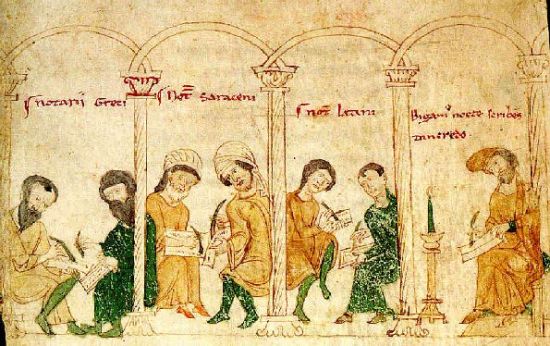
Our Institute sets out to provoke a rethinking of the history of the Middle Ages, c. 1000–1500, through the optic of the medieval Mediterranean, emphasizing questions of religious and ethnic pluralisms, cultural contact, hybridity, transculturation, and the negotiation of identities. As a region whose history of connectivity can be documented over at least two and a half millennia, the Mediterranean has recently become the object of innovative scholarship in various disciplines. Rather than focusing on the internal structure and development of discrete entities (political states, ethnic or religious groups, cultural traditions), these approaches tend to shift their attention to a study of interconnectedness and dynamics of interaction. In contrast to traditional accounts that cast the Middle Ages as the lull between the loss of the culture of classical antiquity and its «rebirth» in Renaissance and that define Modernity as the product of a northern European Enlightenment, our approach reveals that many «modern» ideas, institutions, and technologies in fact first crystallized in the medieval Mediterranean. A short list of examples might include: municipal republics, double-entry accounting, neo-Aristotelian logic, vernacular literature, paper, rice cultivation, universities, and codified public law (on the Roman model).
The emphasis on contact and circulation invites a nuanced reconsideration of recent (and not-so-recent) conceptualizations of modes of interaction between Christian, Muslim, and Jewish societies. Paradoxically, the medieval Mediterranean—often cast as a site of the origin of Christian-Muslim hostility, in the form of the Crusades—has also been idealized as the site of «convivencia,» the harmonious coexistence of Christian, Islamic, and Judaic cultures. The facility with which ideas and technologies traversed the Mediterranean is testament to the commonalities underlying the superficial, if dramatic, contrasts between ethnic and religious groups. By moving from an essentialist to a process-oriented understanding and emphasizing the variety of interconfessional interactions in the medieval Mediterranean, we situate «Holy War» as one pole of a spectrum that includes co-existence, accommodation, and outright cooperation.
At the crossroads of northern European, African, and Middle Eastern cultures, linked (via long-distance trade) to South and East Asian influences, the Mediterranean played a key role in the emergence of the modern West in ways the emerging field of Mediterranean Studies has begun to document. Our contribution to a revised genealogy of modernity begins with an insistence on understanding medieval phenomena—the early commercial development of centers like Venice or Genoa, the recovery of Greek learning and Aristotelian method through the translation of Arabic texts—not teleologically (tracing the origins of the rise of capitalism or the sources of «western» scientific method) but synchronically (acknowledging the vitality, for example, of Latin Europe’s economic and cultural links to the Islamic world). Only through such situated analyses of medieval Mediterranean versions of phenomena such as identity construction, cultural and confessional interactions, modes of political organization, commercial exchange, colonialism, and perceptions of others can we effectively assess and understand these phenomena in subsequent periods.
Detailed program information will be available on this site after Thanksgiving:
The Mediterranean Seminar website www.mediterraneanseminar.org
Faculty & Directors:
- Brian A. Catlos (Religious Studies, University of Colorado at Boulder; History, University of California Santa Cruz), co-Director & Faculty
- Sharon Kinoshita (Literature, University of California Santa Cruz), co-Director & Faculty
- Charles Burnett (History of Islamic Influences, Warburg Institute), Faculty
- O. Remie Constable (History, Notre Dame University), Faculty
- Peregrine Horden (Medieval History, University of London), Faculty
- Karla Mallette (Romance Languages & Near Eastern Studies, University of Michigan), Faculty
- G.A. (Gerard) Wiegers (Religious Studies, University of Amsterdam), Faculty
- Fernando Salmón (History of Science, Universidad de Cantabria), Faculty
Important Dates:
1 March 2012 – Email and postmark dealine for your full application.
2 April 2012 All applicants will be notified of their status (accept, reject, alternate).
6 April 2012 Deadline for Summer Scholars to accept or decline their offer.
2 July 2012 – Institute Begins
27 July 2012 – Institute Concludes
—————————————————
Thanks to Rachel Amado Bortnick for this information