eSefarad Noticias del Mundo Sefaradi

Decimated during the Shoah, the Jewish community of Rhodes was brought to life last month when 35 people from around the world journeyed to the island for a special moment. Vic Alhadeff* was among the visitors.
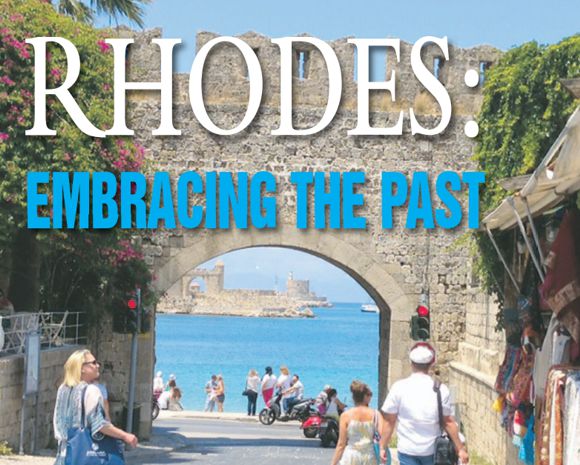
LAST month, I went to synagogue for a Friday night service with my son-in-law, my future son-in-lawand his father.We satin the back rowon the left in the 9th, 10th, 11th and 12th seats from the door. The synagogue filled, the rabbi called out the page numbersin Sephardi and Ashkenazi prayer-books, and the proceedings began.
So why is this of interest? What makes a Shabbat service newsworthy? Why was this night different from every other night?Because it was a Shabbat service like no other. It was a Shabbat service which brought together 35 people from Israel, the US, South Africa and Australia with the objective of celebrating the aufruf of my daughter’s fiance.In so doing, we honoured a once-vibrant communitywhich had been decimated by the Holocaust.
We paid tribute to a community that saw one-third of its finest destroyed in the Nazi camps,leaving but a handful to call it home. We brought the Jews of Rhodes back to life.
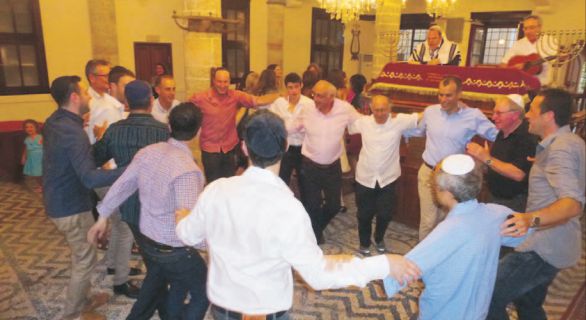
Melbourne paediatrician Lionel Lubitz on guitar
THE Jewish community of Rhodes Island numbered 5000 at its peak. So vibrant wasit, so rich in tradition, that it was dubbed Little Jerusalem. But its world came crashing down on September 1, 1938. That Friday evening, the community was shattered to learn that Mussolini had enacted a raft of decrees that effectively spelt the beginning of the end forthe Jews of Rhodes.
Jews were henceforth forbidden to attend public schools, teach, own properties, manage businesses or serve in the army, Jewish graves were to be exhumed, kosherslaughtering was banned, other Italians were forbidden from marrying Jews, Jewish schoolswere closed and Jews who had settled on Rhodes in the previous 20 years had to emigrate or be imprisoned,fined and expelled.
The community was devastated and many made plans to emigrate.My fatherwas 25, an accountant – and engaged to be married to Becky Hassan.
Fast-forward five weeks. Yom Kippur. My father spent the day in synagogue with his father. The following day he set sail for South Africa – never to see his parents again.
His intention was to settle in Zimbabwe (then Rhodesia) and bring out his parents,teenage sisters and Becky, his fiancee. It wasn’t to be. His parents and sisters were deported to Auschwitz, where his mother was gassed on arrival and his father perished towards the end of the Holocaust. What of Becky? She too was deported to Auschwitz and thatwasthe last he heard of her. Informed that she had perished, he married the woman who became my mother.
Some years ago,my fatherwas on holiday in Cape Town – and overheard the name, Becky Hassan. The sameBeckyHassan towhom he had
been engaged half-a-century earlier. She had survived – and had been told he had perished – andwas living in Belgium, a grandmotherin her 70s. He was a grandfather, also in his 70s, living in Johannesburg. Several months later, he flew to Belgium and they spent an hour reminiscing at Brussels Airport.
WHEN Jews were banished from Spain during the Inquisition, they dispersed across Europe, many finding refuge on Rhodes. The Spanish, or Sephardic, Jews outnumbered the original inhabitants and their language, Ladino, and customs became theway of the land.
They initially lived in peace under the Knights of St John until the Knights ordered them to accept Catholicism or be expelled or put to death. For a period the community was virtually non-existent, so it welcomedthe conquest of Rhodes by the Turk, Suleiman the Magnificent. Jews returned to their faith and the community flourished unde rTurkish rule for 400 years.
Most lived in the Jewish quarter – a fortress of cobbled streets, narrow alleyways andopen-airmarkets.They were confined to a dozen streets, the names of which had a charming logic–The Wide Street, The Coldand Windy Street, The Street to the Sea, The Street of the Great Synagogue, The Street of the Figtrees, The Street of the Crazy Ones.
A vibrant community, it included six synagogues, a school, kashrut facilities and the pride of the community – a rabbinical college with an international reputation and where mymother’s father was the principal. My father, whose father was a tailor, was a translator at Salamon Alhadeff & Son, one of the island’s largest banks with a staff of 500 and 20 branches on the mainland.
It was a community steeped in tradition. The family gathered to light the Shabbat candles, which the mother did with her head covered. After the blessing over the wine, children kissed their parents’ hands andwere told “We hope to see you married”.
It devised its own remedies: headaches were treated with slices of potato and cucumber on the forehead, while infected eyes were washed with tea and blue beads around the forehead. And it had superstitions. If you saw a hunchback, it was good luck. If you touched the hunchback, it was better luck. You never drank waterwhile standing .Babies born on Fridays were considered intelligent. Andif a child had hiccups, parents intoned “Let the hiccups go to the bottom of the sea and keep my child from harm”
This was the community whose existence came crashing down in 1938. Of the 5000 Jews, over 3000 departed – my mother’s Menashe family on the last ship that was allowed to leave.Italian forces occupied the island and the remaining 1757 Jewslived relatively peacefully forfive years.
But Italy capitulated and on July 19, 1944 German forces arrived – with ordersto liquidate the community.The Jewswere ordered to report to the Aviation Palace, where they were held for four days with neither food norwater
Turkish Consul-General Selahattin Ulkumen, a Muslim aged 30,was aware that 42ofthe incarcerated Jews had Turkish origins. “I went to the commander, General Von Kleeman, and asked him to release the 42,” he said later. “The commander said that according to Nazi law, all Jews had to go to concentration camps because Germany needed manpower. But I knew their real purpose – to killthem in the gas chambers. So I objected. I said Turkish law didn’t differentiate between whether a citizen was Jewish, Christian or Muslim. According toTurkish law, all citizens are equal. I said I would advise my government and it would cause an international incident.”
Ulkumen saved the 42, issuing Turkish passports to them against Nazi orders and enabling them to flee. Five of the 42 were Alhadeffs, members of my family.
He paid a price for his courage. German aircraft bombed the consulate, where his wife was about to give birth. She was injured, yet had the baby and died a week later. Her mother committed suicide on hearing of her daughter’s death. Turkey severed relations with Germany and Ulkumen was arrested. He survived and was declared a Righteous Among the Nationsin 1990.
On July 23, 1944 the 1757 Jews were marched to the port, deported to the main land on three cargo vessels and transported to Auschwitz, where 1604 were murdered, including 151 Alhadeffs
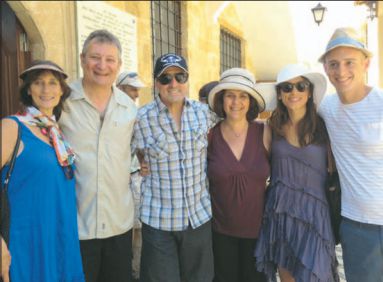
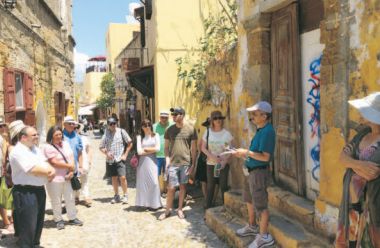
THIS was the community whose memory we honoured last month.Thirty-five of us assembled outside the modest yet magnificent 450-year-old Kahal Synagogue that Friday morning for a “Jewish walking tour” of Rhodes. Our leader was Isaac Habib, a knowledgeable South African whose family was from Rhodes and who spendsfour months a yearthere as a guide.
He led us to the sites of the rabbinical college; the French Jewish school established by Baron Edmond de Rothschild;the remains of synagogues destroyed by Royal Air Force bombers attacking German troops; the cobbled square where Jews socialised, known today asThe Square ofthe Jewish Martyrs; the Chevra Kadisha; the recentlybuiltsix-sided Holocaust memorial, each face inscribed in a different language – and Alhadeff Street and Alhadeff Park, where we paused for a team photograph.
The service that evening –heldin the synagogue in which the Jewish story is infused in every brick, ingrained in every stone of the mosaic floor – was preceded by Melbourne paediatrician Lionel Lubitz leading a rousing preKabbalat Shabbat on his guitar, prompting congregants to break into spontaneous dance. And the following morning, the Sydney Jewish Learning Centre’s Rabbi David Blackman conducted the aufruf, a profoundly poignant moment given the community history and the family story.
Asforthe seatsinwhichwe sat – they were the seats in which my father sat the last time he saw his father. OnYom Kippur 1938, before the latter was deported to Auschwitz.
The cliche about strength in numberswasnevermore applicable. And there was a palpable sense that my father, my grandfather before him –whom I’d never had the privilege of meeting – and allthe Jews of Rhodes knewthatwewere there.
Written by Victor Alhadeff, son of Salvo.
* Vic Alhadeff is chief executive officer of the NSW Jewish Board of Deputies.
Fuente: INTERNATIONAL NEWS The Australian Jewish News –jewishnews.net.au – Friday,July19,2013