 eSefarad Noticias del Mundo Sefaradi

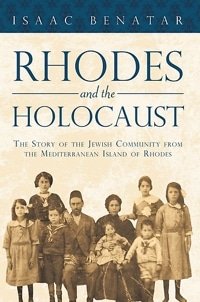
Rhodes and the Holocaust is the story of «La Juderia,» the Jewish community that once lived and flourished on Rhodes Island, the largest of the twelve Dodecanese islands in the Mediterranean Sea near the coast of Turkey. While the focus of the accounts of the Holocaust has for the most part been on the Jewish populations of Eastern and Middle Europe, little seems to be known of the events that affected those communities in Greece and the surrounding Aegean Islands during that time.
The population of this group was almost annihilated, reduced from a thriving community of over 80,000, to less than a 1,000 survivors, who were left to tell their stories. Among the victims of Rhodes Island were the grandmother and aunt of the author, who were killed by falling bombs, and his grandfather, who was taken to the Auschwitz concentration camp.
This history tells of the deceit and inhuman treatment the entire Jewish community of Rhodes experienced during their deportation and eventual «liberation» by the Russian Army.
The heart-wrenching story of the Rhodes Jewish community is told through the experiences of a thirteen-year-old boy, taken by the Nazis to Auschwitz along with his father and his eleven-year-old sister.; Most of all, Rhodes and the Holocaust makes known the story of that community’s existence and struggle for survival.
BOOK REVIEW
Isaac Benatar, Rhodes and the Holocaust: The Story of the Jewish Community from the Mediterranean Island of Rhodes. Bloomington, IN: iUniverse, 2010.
by Ralph Tarica
The Holocaust, with its infinitely diverse torture techniques and its massacres of fellow human beings by the hundreds, the thousands and the millions, still defies our comprehension. No matter how straightforward the cold facts depicted during the period – the numbers tattooed on arms, the convoys of cattle-cars headed for extermination camps, the brutal murder of babies – our intelligence is simply baffled by the sheer enormity of the event. As someone in this book says about the Nazi predilection for creating horrible places for their victims – “standing cells,” “starvation cells,” “dark cells” — “He wondered whether they had nothing better to do with their lives other than to dream up such macabre places to kill” (p. 43). And one can wonder, too, how it was that as late as 1944, with clear signs that their regime might soon fall, the Nazis had nothing better to do with their lives than to round up the Jewish population of the islands of Rhodes and Cos, almost 2,000 of them, pack them up onto boats headed for Greece and then onward by train to their massacre at Auschwitz-Birkenau and similar extermination places.
The author of this book has wisely chosen to depict the events as a human drama by telling us the stories of individual human beings, as retold by surviving witnesses after the war – stories that we can easily understand and relate to but which at the same time exemplify larger and more generalized experiences. The book begins on the hopeful note of “Rhodeslis” deciding in the early 20th century to emigrate to other lands so as to improve their lives and that of their
families: to the United States, Argentina, the Belgian Congo, southern Africa, etc. Readers will undoubtedly recognize a recurrent family pattern: the children go off but the parents stay behind, believing that it is too late for them to begin life anew, often with one younger child remaining behind to look after them. So it is with Isaac and Djoya who stay on with their daughter Alegra.
The Italian occupation of the area, while repressive, is not a murderous one, but once Italy surrenders to the Allies, the Germans arrive to take their place — and with a vengeance, as they soon begin catching and killing even the Italian soldiers. Because Rhodes has an important deep-water port, adjacent to the Jewish quarter – the Djuderiya – the British send planes to bomb it, and in one such raid Djoya and Alegra are killed. As for Isaac, after spending twelve horrendous days on board ship headed for Greece and while en route through the Balkans in an unspeakably filthy cattle-car, a German soldier strikes his head with the butt of his rifle, fracturing his skull and killing him. A young friend of Alegra’s, Samy, will serve as eyewitness for this part of the story until the end of the book.
This is not a work of fiction. Isaac and Djoya Hanan are the author’s maternal grandparents; Alegra was his aunt; Samy Modiano went on to survive Auschwitz, underwent “liberation” by the Russian troops (liberation here meant free to go anywhere he liked, hardly a viable option for a 14-year old boy who had lost everyone and everything), and walked his way with an older friend from Germany to Austria, to finally arrive in Rome. Along the way we get a detailed depiction of life led under the most harrowing of circumstances; for example the way Samy is tempted to end it all by throwing himself onto an electrified fence, like so many others weary of their misery, or the way he cheats death by pretending to be dead lying hidden in a pile of rotting corpses. Samy Modiano eventually overcame his physical and psychological wounds and wound up spending summers in Rhodes giving lectures at the Jewish Museum and Historical Foundation headed by Aron Hasson. And that is where the author met Samy, on a return trip to Rhodes in 2007 to honor the memory of his grandparents Isaac and Djoya and his aunt Alegra.
A review such as this can hardly do justice to the myriad experiences, both gruesome and heart-wrenching, depicted here, as well as the miraculous escapes from death afforded the fortunate few. Benatar’s book is another necessary contribution to Holocaust literature regarding the Sephardic Jews, whose struggle for survival has been generally overshadowed by the literature focused on the Jews of Eastern Europe. Photographs at the end of the book add greatly to its emotional power. The book will be treasured as a testimonial to all the martyred Jews of Rhodes. As the author says: We must never forget.
Author’s Comments:
My maternal grandparents were killed as a result of the Nazi occupation on the Island of Rhodes. My grandmother and aunt were killed by falling bombs and my grandfather by being taken to Auschwitz Concentration camp.
While much of the focus of the accounts of the Holocaust refer to events as they affected the Jewish populations of Eastern and Middle Europe such as France, Poland, Hungary and Czechoslovakia, little seems to be widely known of events that took place in Greece and the surrounding Aegean Islands. Perhaps, it is because their population was almost annihilated from a thriving community of over 80,000, to less than a 1,000 survivors to tell their stories.
This is the story of the community of Rhodes Island, the largest of the twelve Dodecanese islands in the Mediterranean Sea, near the coast of Turkey.
In August, 2007, I traveled to Rhodes to pay my respects at the grave sites of my grandparents and aunt. I also did a daily pilgrimage to the “Shalom” synagogue the oldest and lone surviving temple of the Jewish quarter.
While at the synagogue, I listened to a lecture given by one of the few survivors of the Holocaust from Rhodes. Now in his late seventies, he had only in the last few years opened up to talking publicly of how, as a thirteen year old boy, he’d been taken to Auschwitz.
Tears poured down my eyes as I listened to him tell of his life on Rhodes. How during the war he had lost his mother to illness, The Nazi’s rounding up the Jewish community, including him, his eleven year old sister and his father. The deceit employed in the preparation,
imprisonment and deportation of the entire Jewish community to a concentration camp. Their inhuman treatment experienced while being transported aboard cargo freighters to Greece,
and by train to Auschwitz. He told of his experiences as a young boy at Auschwitz and of losing his father and eleven year old sister to the horrors of the camp. He described how the eventual “liberation” by the Russians left the survivors of the concentration camp abandoned to the mercy of the forces of nature during a brutally cold Polish winter. He spoke of getting to freedom in Italy and starting a new life as a merchant in Africa’s Congo, but always carrying with him a burden – the memories of his experiences. He is one of the innocents who were victims of the concentration camps.
This is the story of the Rhodes community and their struggle for survival
Isaac Benatar, Author
BOOKS BY ISAAC BENATAR http://mysite.verizon.net/

Dear Mr. Benatar. You have done important work. I tride to connect to the website you indicated, but got a message that it was locked. If you don’t mind, let me know how you can unlock it.
Rachel Bortnick
Pleas forgive my typographical error in the word «tried».
Rachel