 eSefarad Noticias del Mundo Sefaradi

From the 17th century onward, choral music became the defining feature of the musical identity of Western Sephardic Jews
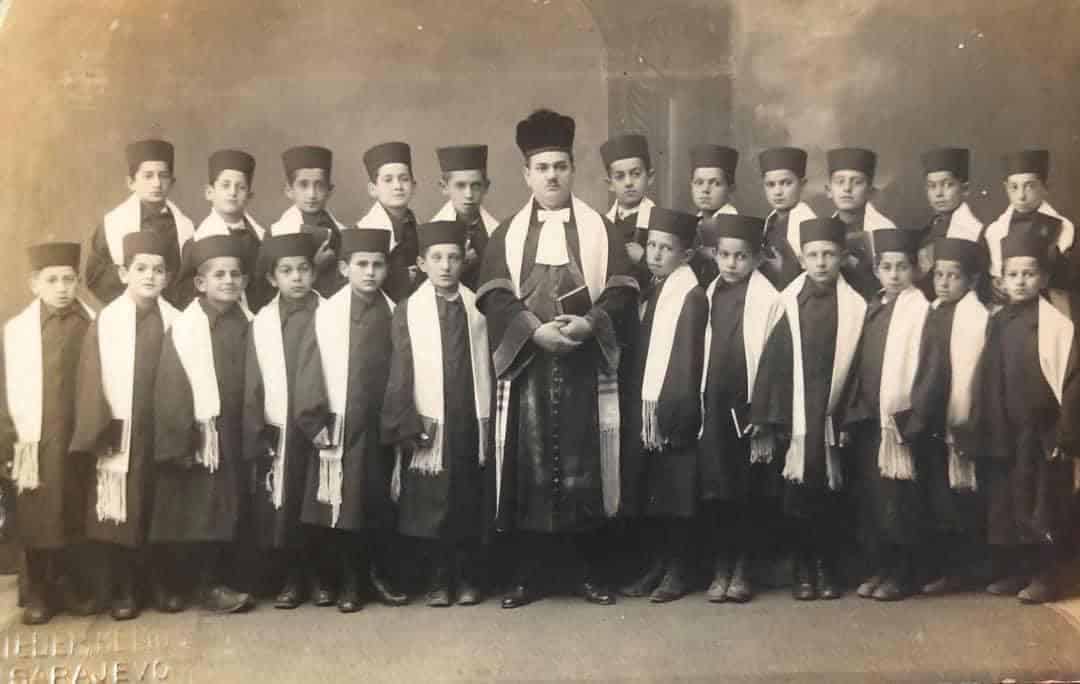
Hazzan and Boys Choir, Sephardic Temple Choir, Sarajevo, early 20th century, Undated.
In about 1724, a young Italian composer ventured into the Jewish Ghetto and visited its resident Sephardi, Ashkenazi, and Italki scuole, or synagogues, to listen to their respective liturgies. Far from a mere wanderer, Benedetto Marcello was a part of a new breed of musicians that were the forerunners of today’s ethnomusicologists. And Marcello was looking for something among the Jews of Venice, the Republic of which he was a citizen: Antiquity.
From the music he heard, some of which was for solo hazzan, some congregational, and some, he says, for choirs of men and boys, Benedetto published eight volumes of solo, instrumental, and choral works over the next four years, each tome decorated with a woodcut of King David playing his harp.
What Marcello captured over time was a snapshot of the beginnings of Sephardic choral music, a tradition that is now four centuries old. The first choral compositions to emerge from the Sephardic community stem from the beginnings of the Western Sephardic (or Spanish and Portuguese) Diaspora in Italy in the 17th century, not long after their flight from Portugal, centered around the cities of Livorno and Venice. Unfortunately, most of these early works do not survive, but what does come down to us exhibits a fusion of cantorial intonation of text with contemporary Italian polyphony.
The first major choral works, however, come from Amsterdam, when these Sephardic Jews from Italy, along with others coming straight from Iberia and southwestern France, settled in the Netherlands. In 1639, they united to form a community called Kahal Kados Talmud Torah. In 1675 they inaugurated their new building with a grand spectacle lasting several days.
The building still stands and is known today simply as “The Esnoga.” For the occasion, a new multimovement choral cantata was composed by anonymous members of the congregation in the Italian Baroque style, harkening back to the Italian origins of its composers. The cantata, called Shir Hanukat Beit HaKenesset, or “Song for the Rededication of the House of Meeting,” sets poetry by the Esnoga’s own Portuguese-born Rabbi, Isaac Aboab de Fonseca, and survives in a manuscript of the 18th-century cantor Joseph ben Sarfati.
Nothing like it had ever existed before. Scored for a cantorial soloist, a choir of men and boys, and a Baroque chamber orchestra, it displays to both the Jewish and Gentile public the cultural achievements and prestige of the Portuguese-Israelite Congregation. The cantata has likely only been performed twice: at its 1675 premiere in Amsterdam and in 2019 by the Jerusalem Baroque Orchestra.
Over the next century, the Amsterdam community would continue to commission cantatas/oratorios, two of which survive. In 1774, the community commissioned Italian (and non-Jewish) composer Cristiano Giuseppe Lidarti to write a Hebrew oratorio in the gallant style popular in Amsterdam at the time about Queen Esther, which was the centerpiece of Purim celebrations at the Esnoga that year, and which has seen renewed performance since 2000.
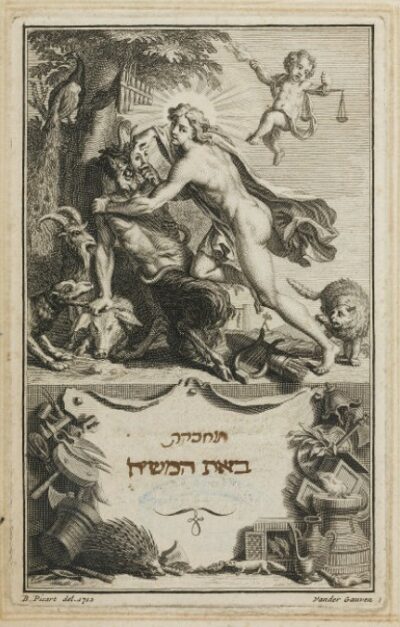
Title plate of ‘Bi’ath HaMashiach’ Oratorium by David Franco Mendes, 1771, Amsterdam. Illustration taken directly from Picard, 1712. (Manuscript EH 47 A 29, Ets Haim Library, Jewish Historical Quarter, Amsterdam)
document and preserve these synagogue hymns as well other facets of Eastern Sephardic liturgical culture.
Others, as has been traditionally the case, aim to play a role in the musical and Jewish education of the community’s next generation, both for their own enjoyment and serve to transmit this intangible musical legacy to a new generation of Sephardim. The foremost among these new (and now co-educational) children’s choirs is Las Estreyikas d’Estambol, directed by Izzet Bana.
Izzet and Las Estreyikas were recently featured in the Netflix series Kulüp—announcing that Sephardic choral tradition is thriving in the 21st century and finding new platforms to share this precious tradition.
A version of this article was first printed in the newsletter of the Sephardic Brotherhood of America, El Ermano Sefaradi, Winter 2023.
Ian Pomerantz is a bass-baritone and co-founder and co-artistic director of Les Enfants d’Orphée. He studies Jewish cantorial music at Abraham Geiger Kolleg at the University of Potsdam in Germany. He is a past member of EMA’s Inclusion, Diversity, Equity, and Access (IDEA) Taskforce.
Fuente: earlymusicamerica.org
