eSefarad Noticias del Mundo Sefaradi

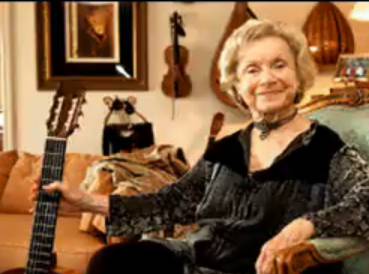
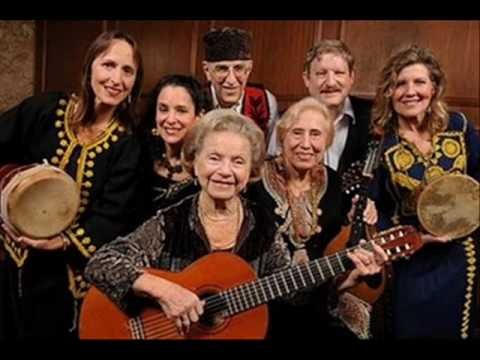
Flory Jagoda, a 2002-2003 Master Artist in the Virginia Folklife Apprenticeship Program , was a 2002 recipient of the National Heritage Award, the highest honor given to a traditional artist in the United States. Susan Gaeta served as her apprentice and is herself a gifted singer and performer. Flory was born in Sarajevo, Bosnia, a member of the musical Altaras family within the Sephardic Jewish community. Through her grandmother, Jagoda learned songs that had been passed down in her family in the generations since Sephardic Jews were forced into exile from Spain and Portugal in the 15th century. These songs are sung in Ladino, or “Judezmo”, the traditional language of the Jews of the Ottoman Empire. Escaping with her parents from the destruction of most of Bosnia’s Jewish community during World War II, Flory is now recognized as the “keeper of the flame” of the Sephardic musical tradition in the United States and internationally, as well as for her new compositions and arrangements of traditional Sephardic songs. Flory has passed this legacy along to her children, musicians themselves, and has worked with many students now performing Ladino music. Together, Flory Jagoda and Susan Gaeta will present an entertaining and enlightening evening of Sephardic song and story.
Saturday, January 22, Reception in O’Mansky Hall at 6:30 p.m., Concert in Main Sanctuary at 7:00 p.m. CBI Members: $10 Non-Members: $15.
Ticket proceeds will benefit the Flory Jagoda Sephardic Music Fund. Tickets can be purchased in advance at the Congregation Beth Israel, Charlottesville, Virginia.

Five questions for Flory Jagoda, Sephardic music’s «keeper of the flame»
Some people sing because they want to. Others because they have to. You might not have heard of her, but Flory Jagoda—an 87-year-old performer of the traditional music of Sarajevo—falls into the latter camp.
Jagoda was born into a family of musicians in Sarajevo, Bosnia, in 1923. The Jewish community there spoke a language called Ladino, a language with roots five centuries deep, when the Spanish Inquisition forced Sephardic Jews to Mediterranean countries. Today, some 200,000 people have some knowledge of the language, mostly in Israel. Ladino speakers number in the hundreds in America, and some of them gather for traditional food and music at Jagoda’s home in Alexandria on a weekly basis.
Jagoda’s family and hometown were destroyed in the Holocaust, and today she is among the few remaining authorities—and expert performers—of her village’s music. (Hence her nickname, «The flame of Sephardic music.») Sarajevo’s distinctive Ladino musical vernacular stepped closer to preservation when Jagoda, who was honored with a NEA National Heritage Fellowship in 2002, came to the attention of the Virginia Folklife Program. The program set up Jagoda with an apprentice, Susan Gaeta, who learned all of the “authentic” music from Jagoda’s native Sarajevo, and will perform alongside Jagoda at Congregation Beth Israel on Saturday.
For Jagoda, the songs she sings in the endangered tongue are a crucial link between the present and a past that was mostly destroyed in the Holocaust. Excerpts from our interview last week follow.
What are your songs about?
They are family songs, songs of love, hate—family. All the songs that I have written, and there are many on my four CDs, are mostly based on family life and family remembrances, melody and memories. Very much it is a picture of the people and the stories of people, very familiar to people who have heard them before.
You have said that Arvoliko, your fourth CD, will be your last. Why stop recording music?
I recorded four CDs, and each one of them is a part of my musical life. The first one was mostly holidays, all the beautiful things I remember from childhood; the second one I wrote many songs for my children and sing with my children; the third one is Sarajevo songs, very much an authentic style of song.
The fourth one actually—you have heard this before from survivors—is that we took one thing with us, and that was silence. We just didn’t want to talk about the past. It was sad. But you go on, and think more and more, and you get a little older. So I thought, maybe with this last one I would just put down reality and truth. What happened to this musical family? We were all musicians.
Have you returned to where you are from in Sarajevo?
My husband was generous enough to get tickets, so we went to this little village, and that’s where I found out that all 42 of them—my family—were killed and thrown into this mass grave. Usually my songs are not as sad as this. I like happy songs, children’s songs, like «Ocho Kandelikas,» which is a very happy Channukah song. But this song was really connected to the end of my family.
Ocho kandelikas
“Arvoliko” means the little tree, and the little mass grave next to the tree is where my whole family is, in a mass grave together. The melody is very melodious; actually, the melody is naturally full of pain, which can help, but there are many, many, more that are very happy, that bring joy and laughter.
Does singing about it help?
If you get it out of your system, then yes. My concert—not to my choice, but to my needs—is to really share it. It does help, and after all, it is something that did happen. Maybe people should know about it. We can’t only have happy and happy songs. That’s not la vita—that’s not life. Life has both. Through songs sometimes you connect, and you almost help people to know there’s both sides.
How did you make your way to America?
I was born in Sarajevo, Bosnia, which was part of Yugoslavia. Maybe you’d better not mix the two and call it Sarajevo, Bosnia, in 1923. I was in Italy working for Americans during the [second World War], when they were hiring civilians. I married a nice Americano, who was in the army. Earlier, we were interned on an island—the Dalmation Islands, near Yugoslavia—and we studied languages. People who really had little to do, so they were teaching the children all they could. One was language, so I was lucky enough to learn a little bit of English, and I used it to work in an office to work for Americans.
Are you aware of other musicians singing in Ladino in the United States?
I don’t know of many—authentically born, no. But in fact I have a little club that gathers on Sunday, a traditional sort of fun gathering, and there are people from Greece, Turkey, Bulgaria, Istanbul—all over Europe who are lucky enough to have run away and to find themselves in this beautiful city of Washington, D.C.
The music is out there, but mine is more authentic because, hey, I’m authentic. I’m 87. Maybe I’m singing a very authentic sound, but I do have students, an apprentice through Jon Lohman’s [Virginia Folklife] program. Luckily, she has learned my songs and now is teaching and performing herself.
«Klaro del Dija»
by Andrew Cedermark, January 17th 09:27am
Source: C-Ville
[print_link]