eSefarad Noticias del Mundo Sefaradi

Biografía de Emma Lazarus
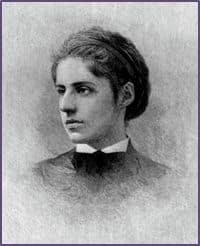
1849 – 1887
Emma Lázaro, nacida el 22 de julio de 1849 en Nueva-York, es la cuarta hija de los siete que tuvieron a Moisés Lázaro y Esther Nathan, una familia estadounidense de origen portugués establecida en Nueva-York desde el período colonial. Originalmente esta familia había huido de la inquisición portuguesa. Anteriormente, una especialista en refinación de azúcar, Emma nació en una familia relativamente rica de Nueva-York y creció en una casa adinerada de Union Square. Por su madre está vinculada a un juez de la Corte Suprema de los Estados Unidos, Benjamin N. Cardozo. Su carácter judío, de origen sefardí, desempeñó un papel importante en su carrera como escritor, y lo influenció en sus decisiones políticas y en la acción pública.
Emma recibe una educación rica y completa, tiene un preceptor que se abre al conocimiento del mundo. Ella está particularmente interesada en la escritura. Desde temprana edad, Emma muestra habilidades excepcionales en la literatura. Se especializa en literatura estadounidense y británica y aprende varios idiomas, entre ellos alemán, francés e italiano. Comienza a escribir poemas que serán publicados por su padre. Esta colección es notada por Ralph Waldo Emerson, quien lo introduce en los círculos literarios de Nueva-York y al mismo tiempo se convierte en su mentor. Publicó otro volumen de poesía, «Admetus y otros poemas» (1871) y una novela, «Alide: Un episodio en la vida de Goethe» (1874) y un drama en verso, «El Spagnoletto» (1876). Después de leer la novela «Daniel Deronda», de George Eliot (1876), una novela que explora el judaísmo en la sociedad victoriana, Emma Lázaro comienza a traducir la poesía hebrea medieval del alemán y algunos ensayos judíos a favor del judaísmo. Una patria en Palestina, trece años antes de que Theodore Herzl fundara el movimiento sionista. Su trabajo más importante es un libro titulado «Cantos de semita», compuesto de poemas con temas judíos y dramas líricos que celebran el coraje judío y defienden la idea de la nacionalidad judía. Estudió hebreo y tradujo poemas clásicos hebreos de las grandes figuras literarias de la edad de oro de España, incluidos los de Judah Halevi y Solomin ibn Gabirol. Muchas de sus traducciones fueron incorporadas más tarde a los libros de oración estándar. Emma también trabaja regularmente en la prensa judía, en el semanario «American Hebrew».
En 1880 se sintió conmovida por el destino de los emigrantes judíos en los Estados Unidos y comenzó a publicar artículos en la prensa local para apoyarlos, más fuertemente después de 1881 y la llegada de inmigrantes rusos en 1881 luego del asesinato. del zar alexander ii (episodio de los pogroms). Hay que decir que este asesinato precedió a una ola de violencia antisemita, la población judía rusa que intentaba refugiarse en los Estados Unidos. En 1882 publicó libros semíticos sobre el tema. Tomando en serio su nuevo papel de bienvenida, abrió un centro de refugiados para los judíos pobres y ayudó a abrir el Instituto Técnico Hebreo en Nueva-York, que ofreció capacitación vocacional a quienes no lo eran. No tienen capacidad de trabajo y por eso les ofrecen autonomía. En Ward Island, trabajó como ayudante para inmigrantes judíos que habían sido arrestados por oficiales de inmigración de Castle Garden. Ella se sintió profundamente conmovida por el destino de los judíos rusos que conoció allí y estas experiencias influyeron en su escritura. Hay que decir que estos inmigrantes eran muy diferentes de los judíos de la clase alta de Nueva-York con los que solía codearse. Estaba particularmente asombrada por los judíos estadounidenses asimilados que parecían avergonzados por estos refugiados judíos, en ese momento muchos judíos estadounidenses no querían asociarse con estos recién llegados simplemente porque temían que estos «judíos diferentes» debilitaran su propia identidad. El estatus social, comprometiendo su capacidad de asimilación en la cultura estadounidense.
Al mismo tiempo, sigue su carrera literaria publicando numerosos poemas. También hace traducciones de poemas alemanes, principalmente los de Johann Wolfgang von Goethe y Heinrich Heine. Ella también escribió una novela y dos obras en cinco actos. En 1883, ante el lento levantamiento de fondos para la construcción del pedestal de la Estatua de la Libertad, tomó una posición a petición de William Maxwell Evarts y del autor de Constance Cary Harrison, escribió un soneto. «The New Colossus» y destinado a subasta en el «Fondo de Préstamos Pedestal de la Estatua de la Libertad de Bartholdi» («Exposición del Fondo de Préstamos en el Fondo de Bartholdi para La Estatua de la Libertad «). Después de ser publicado en el New York World de Joseph Pulitzer, así como en el New York Times, y así ganar popularidad, el soneto se desvaneció lentamente de la memoria colectiva. No fue hasta 1901, 17 años después de la muerte de Lázaro, que Georgina Theodora, una de sus amigas, encontró un libro que contenía este soneto (¡en una librería!) Y logró resucitar la obra que se creía perdida. Sus esfuerzos dieron sus frutos en 1903, con la creación de una gran placa de cobre en la que se grabó este soneto, y que el visitante puede ver en una pared del museo de la estatua, en la misma base.
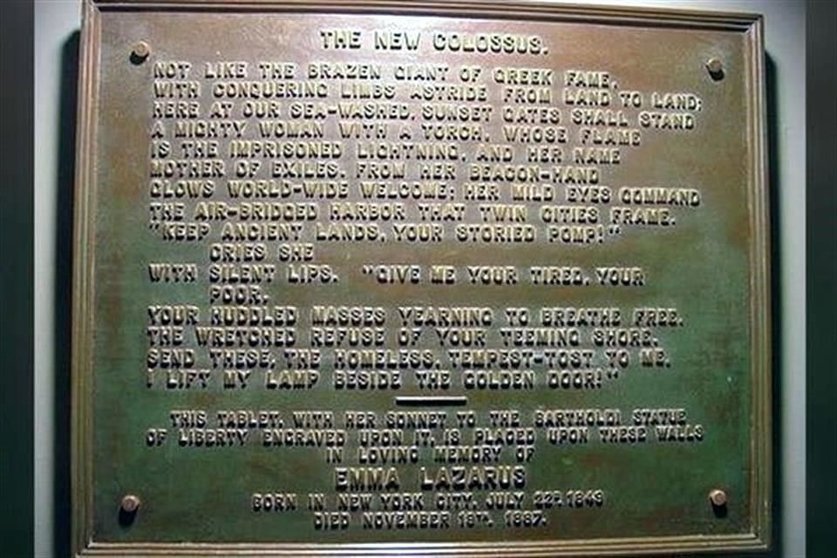
The New Colossus
En 1883 realizó un primer viaje a Europa. En marzo de 1885 murió su padre, y dos meses después, en mayo de 1885, hizo un segundo viaje, todavía en Europa (Italia, Reino Unido). Repetirá un viaje de este tipo en septiembre de 1887 al que volverá fuertemente debilitado. Emma Lazarus murió dos meses después, el 19 de noviembre de 1887, en Nueva-York, a la edad de 38 años. Está enterrada en el cementerio Beth-Olom en Brooklyn.
Emma Lázaro ha sido una importante precursora del movimiento sionista en los Estados Unidos. Ella abogó por la creación de una patria judía trece años antes de que Theodor Herzl comenzara a usar la palabra «sionismo» mucho antes de que fuera popularizada. Fue honrada por la Oficina del Presidente de Manhattan Borough en marzo de 2008 y su hogar en West 10th Street forma parte del circuito sobre la historia de los derechos de las mujeres y los lugares históricos. En 2012 el Museo del Patrimonio Judío lo presenta en una exposición especial. También fue una de las primeras admiradoras de Henry George.
Emma Lázaro tiene un memorial en Nueva-York, él está en Battery Park, al sur de Manhattan. Su dirección exacta es Neighborhood Financial District, NY, EE. UU., Estados Unidos. Es una placa de bronce de 1955 donada a la ciudad por la Organización de Federaciones de Mujeres Judías.
The New Colossus
Aquí está el poema en su idioma original, el inglés. Su traducción y explicación del poema está en esta página dedicada a él.
The New Colossus
Not like the brazen giant of Greek fame
With conquering limbs astride from land to land;
Here at our sea-washed, sunset gates shall stand
A mighty woman with a torch, whose flame
Is the imprisoned lightning, and her name
Mother of Exiles. From her beacon-hand
Glows world-wide welcome; her mild eyes command
The air-bridged harbor that twin cities frame,
«Keep, ancient lands, your storied pomp!» cries she
With silent lips. «Give me your tired, your poor,
Your huddled masses yearning to breathe free,
The wretched refuse of your teeming shore,
Send these, the homeless, tempest-tost to me,
I lift my lamp beside the golden door!
Otros poemas de Emma Lazarus
Aquí hay algunos poemas de Emma Lazarus, una autora bastante prolífica.
1492
Thou two-faced year, Mother of Change and Fate,
Didst weep when Spain cast forth with flaming sword,
The children of the prophets of the Lord,
Prince, priest, and people, spurned by zealot hate.
Hounded from sea to sea, from state to state,
The West refused them, and the East abhorred.
No anchorage the known world could afford,
Close-locked was every port, barred every gate.
Then smiling, thou unveil’dst, O two-faced year,
A virgin world where doors of sunset part,
Saying, «Ho, all who weary, enter here!
There falls each ancient barrier that the art
Of race or creed or rank devised, to rear
Grim bulwarked hatred between heart and heart!»
City Vision
As the blind Milton’s memory of light,
The deaf Beethoven’s phantasy of tone,
Wroght joys for them surpassing all things known
In our restricted sphere of sound and sight,–
So while the glaring streets of brick and stone
Vix with heat, noise, and dust from morn till night,
I will give rein to Fancy, taking flight
From dismal now and here, and dwell alone
With new-enfranchised senses. All day long,
Think ye ‘t is I, who sit ‘twixt darkened walls,
While ye chase beauty over land and sea?
Uplift on wings of some rare poet’s song
Where the wide billow laughs and leaps and falls,
I soar cloud-high, free as the winds are free.II
Who grasps the substance? who ‘mid shadows strays?
He who within some dark-bright wood reclines,
‘Twixt sleep and waking, where the needled pines
Have cushioned al his couch with soft brown sprays?
He notes not how the living water shines,
Trembling along the cliff, a flickering haze,
Brimming a wine-bright pool, nor lifts his gaze
To read the ancient wonders and the signs.
Does he possess the actual, or do I,
Who paint on air more than his sense receives,
The glittering pine-tufts with closed eyes behold,
Breathe the strong resinous perfume, see the sky
Quiver like azure flame between the leaves,
And open unseen gates with key of gold?
Matin
Gray earth, gray mist, gray sky:
Through vapors hurrying by,
Larger than wont, on high
Floats the horned, yellow moon.
Chill airs are faintly stirred,
And far away is heard,
Of some fresh-awakened bird,
The querulous, shrill tune.
The dark mist hides the face
Of the dim land: no trace
Of rock or river’s place
In the thick air is drawn;
But dripping grass smells sweet,
And rustling branches meet,
And sounding water greet
The slow, sure, sacred dawn.
Past is the long black night,
With its keen lightnings white,
Thunder and floods: new light
The glimmering low east streaks.
The dense clouds part: between
Their jagged rents are seen
Pale reaches blue and green,
As the mirk curtain breaks.
Above the shadowy world,
Still more and more unfurled,
The gathered mists upcurled
Like phantoms melt and pass.
In clear-obscure revealed,
Brown wood, gray stream, dark field:
Fresh, healthy odors yield
Wet furrows, flowers, and grass.
The sudden, splendid gleam
Of one thin, golden beam
Shoots from the feathered rim
Of yon hill crowned with woods.
Down its embowered side,
As living waters slide,
So the great morning tide
Follows in sunny floods.
From bush and hedge and tree
Joy, unrestrained and free,
Breaks forth in melody,
Twitter and chirp and song:
Alive the festal air
With gauze-winged creatures fair,
That flicker everywhere,
Dart, poise, and flash along.
The shining mists are gone,
Slight films of gold swift-blown
Before the strong, bright sun
Or the deep-colored sky:
A world of life and glow
Sparkles and basks below,
Where the soft meads a-row,
Hoary with dew-fall, lie.
Does not the morn break thus,
Swift, bright, victorious,
With new skies cleared for us,
Over the soul storm-tost?
Her night was long and deep,
Strange visions vexed her sleep,
Strange sorrows bade her weep:
Her faith in dawn was lost.
No halt, no rest for her,
The immortal wanderer
From sphere to higher sphere,
Toward the pure source of day.
The new light shames her fears,
Her faithlessness, her tears,
As the new sun appears
To light her godlike way.
Influence
The fervent, pale-faced Mother ere she sleep,
Looks out upon the zigzag-lighted square,
The beautiful bare trees, the blue night-air,
The revelation of the star-strewn deep,
World above world, and heaven over heaven.
Between the tree-tops and the skies, her sight
Rests on a steadfast, ruddy-shining light,
High in the tower, an earthly star of even.
Hers is the faith in saints’ and angels’ power,
And mediating love–she breathes a prayer
For yon tired watcher in the gray old tower.
He the shrewd, skeptic poet unaware
Feels comforted and stilled, and knows not whence
Falls this unwonted peace on heart and sense.
Links
The little and the great are joined in one
By God’s great force. The wondrous golden sun
Is linked unto the glow-worm’s tiny spark;
The eagle soars to heaven in his flight;
And in those realms of space, all bathed in light,
Soar none except the eagle and the lark.
Restlessness
Would I had waked this morn where Florence smiles,
A-bloom with beauty, a white rose full-blown,
Yet rich in sacred dust, in storied stone,
Precious past all the wealth of Indian isles-
From olive-hoary Fiesole to feed
On Brunelleschi’s dome my hungry eye,
And see against the lotus-colored sky,
Spring the slim belfry graceful as a reed.
To kneel upon the ground where Dante trod,
To breathe the air of immortality
From Angelo and Raphael-TO BE-
Each sense new-quickened by a demi-god.
To hear the liquid Tuscan speech at whiles,
From citizen and peasant, to behold
The heaven of Leonardo washed with gold-
Would I had waked this morn where Florence smile!
The Banner Of The Jew
Wake, Israel, wake! Recall to-day
The glorious Maccabean rage,
The sire heroic, hoary-gray,
His five-fold lion-lineage:
The Wise, the Elect, the Help-of-God,
The Burst-of-Spring, the Avenging Rod.
From Mizpeh’s mountain-ridge they saw
Jerusalem’s empty streets, her shrine
Laid waste where Greeks profaned the Law,
With idol and with pagan sign.
Mourners in tattered black were there,
With ashes sprinkled on their hair.
Then from the stony peak there rang
A blast to ope the graves: down poured
The Maccabean clan, who sang
Their battle-anthem to the Lord.
Five heroes lead, and following, see,
Ten thousand rush to victory!
Oh for Jerusalem’s trumpet now,
To blow a blast of shattering power,
To wake the sleepers high and low,
And rouse them to the urgent hour!
No hand for vengeance-but to save,
A million naked swords should wave.
Oh deem not dead that martial fire,
Say not the mystic flame is spent!
With Moses’ law and David’s lyre,
Your ancient strength remains unbent.
Let but an Ezra rise anew,
To lift the BANNER OF THE JEW!
A rag, a mock at first-erelong,
When men have bled and women wept,
To guard its precious folds from wrong,
Even they who shrunk, even they who slept,
Shall leap to bless it, and to save.
Strike! for the brave revere the brave!