eSefarad Noticias del Mundo Sefaradi

My husband and I enjoyed a unique trip to Portugal where we visited and interacted with three distinct Jewish communities. The excursion was organized by a friend who has devoted much time reaching out to help Jews in remote areas. In our group of seven, there were three “returnees.” One was our friend and guide – himself born in the Azores to a Catholic family.
It is estimated that a good deal of the Portuguese population have antecedents in Judaism. There was an influx of Jews expelled from Spain in 1492 (the Inquisition), but a turn of events in 1497 caused this ultimatum: convert, die or leave. Many ‘New Christians’ secretly maintained their faith. Some of their descendants are today delving into their Jewish roots. They are often referred to as Marranos – a pejorative term meaning pig in Portuguese. Some still deliberately call themselves that. The terms returnees or B’nai Anousim are also used.
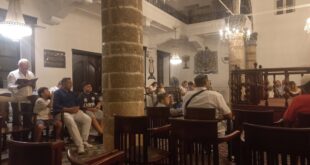
Our introduction to Jewish Portugal was in Lisbon with such a community, the members of Ohel Ya’akov. The shul is a converted house – a fourth floor walk-up – and is considered a magnificent improvement over their last premises. The look of pride in their eyes remains a highlight of this trip.
Each has a story with a common theme, a mystical connection to Judaism that links them to their ancestors.
When we later returned to Lisbon and Ohel Ya’akov, they felt and acted like old friends. We attended Shabbat services and were treated like visiting royalty.
They couldn’t do certain prayers because there wasn’t a minyan. In our culture that usually means they don’t recognize the women. Here it meant that some in the room had not completed their conversion.
Then there was a never-ending meal. Among the foods served, some local dishes were codfish cakes instead of gefilte fish, and Portuguese “biscuit cake” served only on special occasions. Birkat Hamazon began about 11:30. After due hugs and more and more kisses, they drove us all home.
Most ironic: we had an appointment to spend time with a young couple still in the process of their conversion, but they cancelled to attend his uncle’s wake.
Our adventure took us next to Belmonte, and as its name suggests, it is very pretty and built on hills.
Belmonte is unique in that they maintained their Crypto-Judaism for 500 years. The women kept it alive, passing it on to their daughters and granddaughters. They traditionally lit candles in the cellar and observed important dates like Yom Kippur a few days late. A child noticed her mother always faced the cross and folded her hands. Years later the mother explained what prayers she was really reciting while “apologizing” for pretending to be Christian.
When Samuel Schwartz, a Polish engineer, visited Belmonte in 1917, they didn’t believe he was Jewish. Thinking they were the only Jews left in the world, they didn’t know one could practice Judaism openly. Only when he recited the Shema did he gain their confidence.
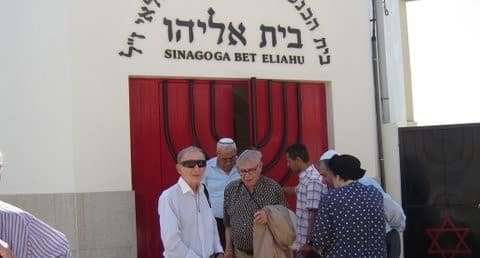
They have since ‘reconverted,’ have a beautiful synagogue and want to learn as much as they can. The Synagoga Bet Eliahu, is in a picturesque location high up in the hills. In its pretty gardens, the grass is arranged to form a Magen David, and there’s a large menorah standing there too. They follow some Orthodox rules zealously, but not others. There was only one other woman present at that Erev Shabbat service, but they wanted me to sit upstairs (with her) in near-impossible heat. I preferred to wait outside, but many men insisted I take a chair and sit inside for the service – albeit near the door.
Saturday evening we attended Ma’ariv and Havdalah services – for this the women are invited to share the main chapel.
In Porto, most fascinating was our meeting with Isabel Basto Lopez, granddaughter of Captain Barros Basto, known as the Captain or the Portuguese Dreyfus. A highly decorated officer during World War I, in 1923 he organized a Jewish community in Porto bringing back to Judaism many who had remained Jews in spirit. He established a Yeshiva, the journal Halapid, and in 1938 – the Mekor Haim Synagogue.
Because of his Judaizing, Basto was expelled from army service and suffered false accusations. Yet he carried on making the Porto community a shelter for refugees of WWII. In Amarante where Basto is buried beside his grandfather in a Christian cemetery, we recited Kaddish and we remember them.
We visited the beautiful Mekor Haim synagogue and stayed for Mincha.
The desire to “come home” by the Marranos in Portugal is inspirational.
Jocelyn Cooper Special to the Tribune
[print_link]