eSefarad Noticias del Mundo Sefaradi

Focus on Jewish Contributions to Economic Expansion of Retail, Industry and Finance in 19th century America
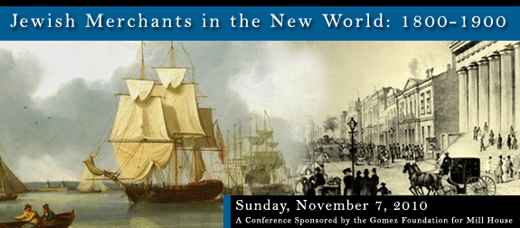
The lesser-known aspects of the Jewish contribution to economic expansion in the United States during the 19th century will be the focus of a conference to be held at the Center for Jewish History on Sunday, November 7, 2010.
Called «Merchants Jews in the New World: 1800-1900» it is being sponsored by The Gomez Foundation for Mill House. It is part of their lead-up to the 300th anniversary of the construction of the Mill House, situated on the upper Hudson River, which was built by one of the earliest Jewish merchants in this country. Sessions will include a panel of presentation on 19th Century developments in three key areas: retail, industry and finance.
Gene Dattel, author of the recently published Cotton and Race in the Making of America: The Human Costs of Economic Power, will deliver the keynote address. He will be followed by a series of roundtable discussions, roundtable summaries, moderated discussions and more.
Participants will include Andrée Aelion Brooks, Jewish historian, journalist and author; Gene Dattel, financial historian and author; Kenneth Libo, Adjunct Professor of History, Hunter College; Bonnie S. Wasserman, Lecturer, Fordham University; Ainsley Henriques, historian; Kate Myslinski, genealogy researcher and writer and Ruth Abrahams, executive director of the Gomez Foundation.
The conference is the second of three to explore the theme of Jewish Merchants in the New World. Ruth Abrahams, executive director of the Gomez Foundation said, «We hope to encourage further dialogue on the topic of Jewish contributions to the founding and development of America.» The prior year’s conference, she noted, covered the early period, 1500-1800, and the 2011 conference will focus upon 1900-present.
The Center for Jewish History is located at 15 West 16th Street, New York, NY 10011. A kosher continental breakfast and buffet lunch will be served. General registration costs $75. Seniors 60 and over, and students under 21, will be offered discount tickets at $65, along with members of the Center for Jewish History, their affiliates and Channel Thirteen. For more information email: Gomez(at)cjh.org. To register, click here.
###
Jewish Merchants in the New World: 1500-1800, is sponsored by The Gomez Foundation for Mill House, a not-for-profit organization registered in the State of New York and established to support the preservation, conservation and public programs of the Gomez Mill House Historic Site and Museum in Orange County, New York, the oldest Jewish dwelling in America. The Gomez Mill House was founded in 1714, by Colonial American Jewish merchant and pioneer, Luis Moses Gomez, and was home to Revolutionary patriot Wolfert Acker, gentleman farmer William Henry. Armstrong, Arts and Crafts paper artisan Dard Hunter, and social activist Martha Gruening. The Mill House is on the National Park Service’s National Register of Historic Places.