eSefarad Noticias del Mundo Sefaradi

by Maya Mirsky

Ladino is a historical language of the Sephardic Jews, an amalgam of 15th-century Spanish and other Romance languages. Traditionally written in Hebrew characters, it is also influenced by Hebrew in vocabulary and structure. It was spoken by the Jews of Spain, who took it with them when they were expelled from the country.
Once spoken across a thriving diaspora that stretched across Southern Europe, the Balkans, North Africa, Turkey and the Middle East, Ladino is now considered endangered. Most native speakers are older than 60 and live primarily in Israel. Estimates suggest only a few tens of thousands remain. One estimate pegged the number of speakers at 60,000 in 1994, and the number has trended downward since then. Many Ladino speakers were killed in the Holocaust, and survivors were uprooted and adopted other languages.
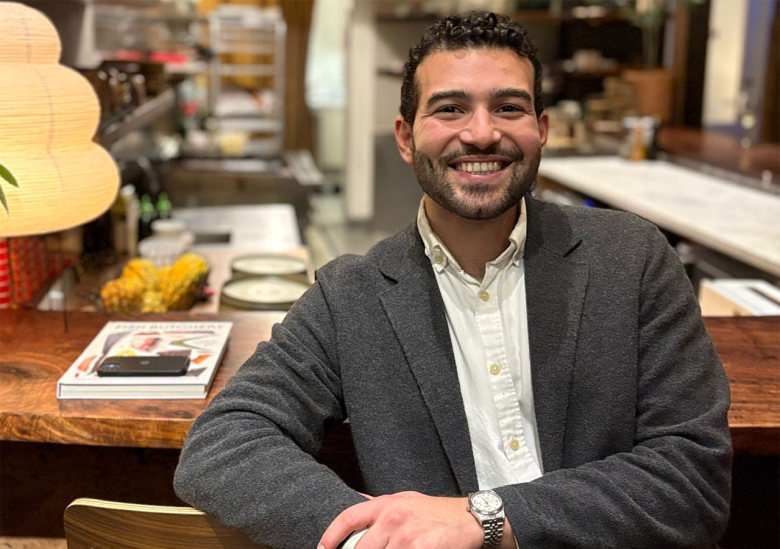
Nesi Altaras, a Turkish Jewish researcher at Stanford, is one of a coterie of historians working to open up this lost world to contemporary generations. He’s giving a talk and workshop on Ladino on April 30 at the Jewish Community Library in San Francisco. The event will explore how the language has carried Sephardic culture across the globe. It’s also a chance to learn some Ladino — no prior knowledge required, although familiarity with Spanish helps.
Altaras sat down with J. to talk about what he’s learned as a scholar and speaker of Ladino, and his own family background.
This interview has been edited for length and clarity.
How did you become interested in a language few people speak?
I was born and raised in Istanbul. My grandparents are native speakers. It’s a language that has had its parent-to-child transmission cut off in almost all places, and certainly in my family as well. So I didn’t grow up speaking the language. I learned it as an adult.
I am a Ph.D. candidate at Stanford at the moment. I study Jews in the late Ottoman Empire and the post-Ottoman world: Turkey, Greece, Syria.
How did Ladino speakers live back then?
What we think about as Ladino culture is really a product of the Ottoman world, the [Jewish] people who are exiled from Iberia in 1492, and in 1496 and 1497 from Portugal and Navarre.
They relocate to the eastern Mediterranean, almost entirely under Ottoman rule, and they bring together elements of different Hispanic dialects and the local languages they encounter, and Italian, Hebrew and, later on, French. They create this language, and its literature is a product of this cultural world.
You study Ladino newspapers. What time period do they cover?
From the 1860s onward, there’s a long-lasting and growing genealogy of Ladino newspapers in Istanbul, in Salonika [Greece] — now Thessaloniki — and Izmir [Turkey], those three being the main hubs, but also in smaller places: in Edirne [Turkey], various cities in Bulgaria, Romania, an outpost also in Vienna, one in Paris.
For hundreds of years, these people lived in one empire. [Later] it’s fractured by borders for the first time and the language is actually a way for the networks to survive and continue, despite now there being an independent Romania, Serbia, Bulgaria.
What can these newspapers tell you about the readers?
Me and a cohort of other historians who read in Ladino have tried to understand how Sephardic Jews relate to becoming Ottomans, or how they relate to ideas about Jews as a nation, like a pre-Zionist Jewish nationalism. And then, of course, how they position themselves vis-a-vis Zionism. Some of them are pro, some of them are anti. Some of them are more ambivalent. There’s also a socialist Ladino press.
I would say this is a very divided population. I mean, it’s not so surprising for Jewish history.
You also looked at how Sephardic Jews saw Ashkenazis. What did you find?
With the pogroms in Romania and Russia, there’s a huge wave of refugees. Many of them stay in the Ottoman Empire and become locals, create Ashkenazi institutions. The relationship with the Sephardim is often tense and adversarial, so that gives rise to some naming practices that can be considered derogatory or dismissive.
I discovered a global sex trade story that really made it much more interesting. There’s a trafficking of Jewish women from the Black Sea coast through Istanbul to Argentina. This is a global story that also connects Romania and Russia to these port cities in the Ottoman Empire, then to Argentina, to the global sex trade.
What do people think about what you do here in California?
There is growing interest from all Jews in diversity among Jews. More and more Sephardi Jews are visible and present in American Jewish institutions. I also think that, because of the prominence of Spanish in contemporary America, a lot of American Jews have familiarity with Spanish. So often, I find that Ladino is very accessible, not just to hear about the language, but to engage with it.
Fuente: jweekly.com