eSefarad Noticias del Mundo Sefaradi

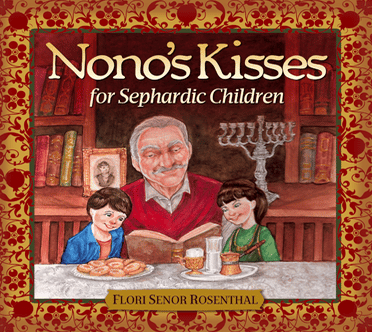 Nono’s Kisses for Sephardic Children is the first of Flori Senor Rosenthal’s Legacy and Literacy Scholastics Series. It is a compilation of nine beautiful illustrations depicting nine phrases in Ladino. Ladino or Judeo-Spanish, is the language of Sephardic Jews which has been declared an endangered language by the United Nations Educational, Scientific and Cultural Organization. Some of the illustrations are reminiscent of memorable actions by Ms. Senor Rosenthal’s children, when they were very little.
With each phrase in the book, there is a question relating to the picture, which will engage the parent and child into a conversation. A list of Ladino words and how they are pronounced, as well as the English translation, is provided to be used in a discussion of that phrase.
One of Ms. Senor Rosenthal’s goals is to make learning Ladino fun for all ages. Therefore, the lists of Ladino vocabulary words, associated with each illustration and phrase, can also be applied and used in other conversations and games the parent and child might have. For example, one of the phrases gives a list of colors in Ladino. So, if the parent and the child are riding in a car, and they decide to play a game about the colors they see around them, they can use the Ladino words for those colors. In addition, and to add to the fun, in every illustration there is a hidden butterfly for children to find.
Nono’s Kisses was inspired by her father and written to honor important ancestral knowledge and the cultural wealth of tradition known specifically to Sephardic Jews. Ms. Senor Rosenthal believes that her series will spark renewed interest in the usage of the Ladino language so that one day soon, it can be taken off the endangered language list.
About the Author
Flori Senor Rosenthal is the author and illustrator of Nono’s Kisses for Sephardic Children. She comes from a family of mixed cultures. Her father was a Sephardic Jew and her mother an Ashkenazi Jew. She felt blessed with learning about the customs and traditions of both cultures from each of her parents. After Ms. Senor Rosenthal’s children were born, her mother was contacted by a long lost relative who told her mother that she was actually Sephardic. From that point on, her mother became Nona, a perfect companion match to her father who was already Nono and the inspiration for the title for her book. As a child, she loved going to the Sephardic Jewish Center in the Bronx with her father. She loved to hear the melodies of the prayers that sounded exotic to her. And she loved to sit with the women in the balcony where she felt like she was the center of attention. She always wanted to speak Ladino, but no one seemed to have the time to teach her growing up. So she learned Spanish in school, but it was not the same. She often wondered about Ladino, as it appeared to be a language in jeopardy. She always thought to revive it somehow. For over 20 years she had the idea of writing and illustrating a children’s book in Ladino but never made it a priority, until now. She spent that time with her wonderful husband, raising their 3 children (all 3 being inspirations for some of her illustrations). She worked and continues to work as a genetic counselor. To stimulate her creative side, she hand paints porcelain Judaica, and designs and prints beautiful invitations and other printed material for special events. Ms. Senor Rosenthal’s parents were remarkable role models, who embodied important Jewish traditions and were always involved in their religious and secular communities. For this reason she has always been involved with charitable organizations and her synagogue. Recently, she joined a Ladino singing group in LA which she enjoys attending with her oldest daughter and a Sephardic friend. She is currently expanding her knowledge of Ladino and finds the online Ladino group, Ladinokomunita, (Ladinokomunita@yahoogroups.com) founded by Rachel Amado Bortnick, a wonderful resource.
Fuente: www.florisenorrosenthal.com