 eSefarad Noticias del Mundo Sefaradi

Karen Gall
From Friday’s Globe and Mail – Friday, Sep. 18, 2009
Carrying my father’s shofar, a horn blown during the High Holidays, led to an impromptu concert at security
A few years ago, while I was visiting Toronto, my father offered me his shofar. He had brought it back from Israel and had proudly blown it at his synagogue during two high holiday seasons.
A shofar is a musical instrument fashioned from a hollowed-out ram’s horn. It has been around since biblical times, when the horn was sounded during ceremonies and holy days. Today, the shofar is primarily sounded during services on Rosh Hashanah, the Jewish New Year, which begins tonight at sundown, and at sunset on Yom Kippur to mark the end of a day of fasting and repentance.
For a number of years, as the ba’al tekiyah , or shofar blower, at our 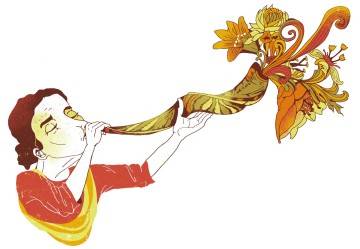 synagogue in Edmonton, I had been using a beautiful, smaller shofar that my husband had brought back from Israel. My father’s shofar, however, was made in the Sephardic style from the long, elegant horn of a kudu antelope. I was honoured he would offer his treasured shofar to me, but I didn’t want him to regret giving it away. “Don’t worry,” he said. “The shofar has been sitting under my bed for 15 years. I’d rather it be used than have it collecting dust.”
My father, Jack Young, died last year. He was a professional musician with a rich baritone voice who played the double bass and mandolin.
He had bought the shofar in 1985 when he and my mother, Estelle, made their only visit to Israel, a trip that was a dream realized. Partway through their vacation, my parents visited the ancient ruins at Caesarea. At the site, a tour group was learning about the Roman amphitheatre. Always the showman, Dad retrieved his new shofar from the car and, much to the astonishment of the other tourists, stepped up onto the ancient stage, put the shofar to his lips and blew.
As the rich sound rang out, the tourists stood and watched, stunned into silence. When the last echoes died away, the guide shrugged and explained to his wide-eyed group, “Don’t worry. It’s just something religious.” This story became part of family lore.
I was excited about receiving his beautiful shofar but I was worried about getting it home safely. Even if I packed it carefully in my baggage, the shofar might get damaged during the flight to Edmonton. I decided the safest thing to do was to take it on board.
When I arrived at the airport, I was advised to confirm with security that I would be allowed to carry it on. If the guards deemed the large shofar to be a dangerous object, I would have to tuck it into a suitcase and hope for the best.
Grabbing my bags, I hurried to security and approached a sympathetic-looking officer. I asked if I would be allowed to carry on this religious object. The security guard asked what it was.
“It’s a hollowed-out antelope’s horn,” I said. “A shofar.”
There were about eight security guards near the station, and as we spoke they started to gather around. “What do you do with it?” someone asked.
“It’s blown to welcome in the Jewish New Year and on our Day of Atonement.”
“Who blows it?”
“I blow it.”
“Can you blow it now?”
“Here?”
By then, all the security guards were gathered around. I wasn’t sure if I was seriously expected to blow the shofar for them, but if this is what it would take to get this family heirloom home safely, why not?
I put the shofar to my lips and blew a long, loud single note: Tekiyah .
“Can you blow it again?” a guard asked.
So I did. This time it was the three notes of Shevarim .
“Again?”
Taking a deep breath, I sounded the nine staccato notes of Teruah .
An angry-looking security officer rushed over, calling at me to stop, but my audience shushed him and eagerly asked for another note. Again and again, the mellow, primal call of the shofar echoed through the cold, expansive hall.
“So,” I finally asked the guards as I paused from my impromptu concert, “Is it okay? Can I carry my shofar onto the airplane?”
The last officer took it from my hands. He peered down one end and then the other. He frowned and opened his mouth to speak, but was interrupted by a chorus of voices: “Of course! Of course you can take it on!”
I hurried back to the airline counter to check in and, shofar in hand, returned to security. The guards had obviously been discussing the shofar while I was gone, because as I went through the line, they each had a different question for me: “When do you blow the horn?”
“What animal did it come from?”
“Can you play a song on it?”
“Where did you get it?”
“What do you call the notes that you played?”
And the best question of all: “Was the shofar passed down through the generations?”
Smiling, I thought of my father handing me his shofar that morning and, with tears in my eyes, I nodded proudly.
For the past few Jewish High Holidays, I have blown this shofar at our synagogue. It is a shofar with a history – a shofar with its own stories that has been blown from Israel to Toronto to Edmonton.
Shanah tovah umetukah – may you have a good and sweet year!
Karen Gall lives in St. Albert, Alta.
Illustration by Kim Rosen.
