 eSefarad Noticias del Mundo Sefaradi

Luis de Carbajal didn’t even know he was Jewish until a brother told him; by the end he thought he was a latter-day Joseph.
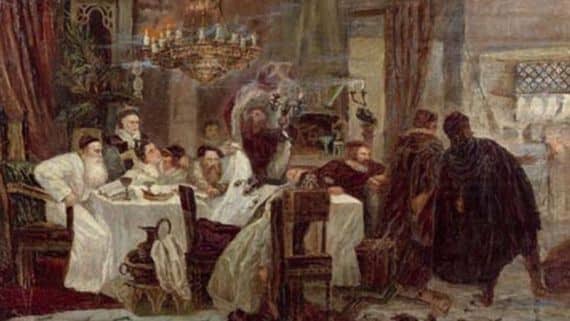
On December 8, 1596, Luis de Carbajal the Younger, together with a total of nine members of his extended family, was burned at the stake in a Mexico City auto da fe. Thus came to an end the long, tragic saga of a family of Portuguese Jews who converted to Christianity, but some of whom continued to secretly practice Judaism.
Luis de Carbajal was born in 1566, in Benavente, in northwestern Spain. His family were New Christians, Jews who had converted under the pressure of crown and church.
He grew up unaware of Jewish roots of his parents, Francisco Rodriguez de Matos and Francisca Nunez de Carabajal, who sent him to a Jesuit school. At the age of 13, however, Luis had his family’s heritage revealed to him by his older brother Baltasar. What Baltasar didn’t reveal – or perhaps even know – was that their parents were continuing to practice some Jewish rituals in secret.
Soon after, in 1580, his parents accepted the offer of Francisca’s brother, Luis de Carbajal y de la Cueva (c. 1540-1595), an explorer and slave-trader, to emigrate to the New World. There, he had been appointed the governor of Nueva Leon province, a huge region compromising contemporary northern Mexico and parts of Texas. (Many historical sources confuse the two men.)
Non-normative but still Jewish
Because of its geographical remoteness, the usual rule requiring immigrants to New Spain to be at least third-generation Christians was suspended in Nueva Leon. Some historians think that Luis the Older, having heard rumors of his sister’s family’s Judaizing, hoped to get them out of harm’s way by inviting them to join him.
In Mexico, the younger Luis began to assist his father in business. When his father fell ill, he started talking with Luis about his Jewish beliefs and practices.
Historian Martin Cohen, author of the 1973 book “The Martyr Luis de Carvajal,” says the crypto-Jews, with very limited access to Jewish texts other than the Bible (which they read in Latin), kept a very non-normative form of Judaism alive. For example, they observed only four Jewish holy days – the Sabbath, Purim, Pesach and Yom Kippur – and marked them on the civil calendar.
In 1587, two years after his father’s death, Luis the Younger became the de facto leader of New Spain’s crypto-Jews, though he kept his activities secret from his Uncle Luis the Elder, who had plans of making his nephew his successor and heir.
Confession under torture
The beginning of the end for the family was in 1890. Luis’ sister Isabella was arrested by the Mexican Inquisition on suspicion of heresy. Under torture, she confessed to being a secret Jew, and in succession, her mother and two of her siblings, one of them Luis, were arrested.
During this, his first imprisonment, Luis the Younger not only succeeded in converting a Franciscan monk whom he met in prison to Judaism, but he convinced the authorities that he had repented, and was in turn sent to work in a school as penance. There he had access to a decent library, which allowed him to pursue serious Jewish studies.
He also began writing his memoirs. These, together with the letters he wrote to his family during his second imprisonment – which were intercepted by the authorities – explain how so much is known about his case (the other reason being the copious records kept by the Inquisition).
Luis was arrested a second time on February 1, 1595. By now, he had begun having visions, imagined himself being a latter-day (biblical) Joseph, and referred to himself as “Lumbroso” – the Illumined One.
The auto da fe planned for December 8, 1596 was one of the largest and most dramatic to be held in the New World, with 48 victims of heresy and lesser crimes burned at the stake, and another eight burned in effigy.
Luis de Carbajal the Younger remained defiant to nearly the end, when, at least according to the confessor assigned to watch him, he supposedly expressed his desire to repent. For that reason, he was permitted to have his neck broken, so that he would be dead before he was consigned to the flames.

Davi B. Green
Haaretz Contributor
Fuente: haaretz,com

In 1997, the San Diego Opera put on the premiere of an opera titled «The Conquistador» based on the life of Don Luis de Carbajal (the Elder). I was privileged to give a lecture connected with this premiere, a slide-lecture on the life of Dona Gracia Nasi, Sephardic (Conversa) heroine of the 16th century. This involvement brought me to Torah B»H and to orthodox conversion to Judaism. Dona Gracia’s husband’s Converso surname was Mendez (or Mendes in Portuguese), which is my family name. Apparently members of the Carbajal family escaped, and their descendants are still to be found. I grew up in Ysleta, Texas, along the Rio Grande that borders Chihuahua, Mexico, where my parents are from. We grew up with Carvajales, Francos, Leyvas, other Sephardic or Jewish names (Leyva e.g. comes from «Levi»), in Catholic communities. Many conversos («Secret Jews» or Marranos, a term which I do not like) fled during the time of New Spain to the northern or far-flung frontiers. I believe that many of the families I grew up with, like mine, are from Sephardic converso descent.
There is an attorney in Dallas Texas, Reid Heller, who is doing research trying to locate Carbajal descendants, especially from the maternal lines, if anyone is interested in contacting him.
p.s. tambien hablo espanol, aunque siendo nacida en los EEUU, me educue en ingles, so me es mas facil expresarme en ingles. En Nuevo Mejico (o «New Mexico» en los Estados Unidos) en donde tambien tenemos parientes, la gente Hispana de las familias viejas de Nuevo Mejico, hablan un espanol un poco extrano para el hispano-parlante de hoy dia. Resulta que muchos terminos y muchas expresiones son igual o parecidas al Ladino.
Shocking-ive found my De leyva family as v early conversos were related v closely to spanish&uk royalty and Don Alonso martinez De Leyva in command of 16 ships from Cadiz -one Rosario here in Torquay Devon -its 420 prisoners were used as hard labour due to Francis Drake looting the ship -gov got 20.000 gold coins back-out of 50.000 leaving Cadiz-e but early conversos got v high up-mine related to Eleanor of Castille -caterrine of Aragon-Catherine of Braganza
pity that all had to be converted. first the jews to christianity and there also the aztecs and maya to christianity.