 eSefarad Noticias del Mundo Sefaradi

Although extensive research on the Holocaust has been conducted in recent decades, the experience of Sephardic Jews on the periphery of occupied Europe, along the Mediterranean, and in Vichy-controlled colonies in North Africa has remained relatively unexplored. Understanding the Sephardic experience during the Holocaust forces us to re?ne our assumptions about its scope and the qualitative differences in the persecution, destruction, resistance, and survival of the varied Jewish communities under occupation. Join us for a symposium exploring the unique history of Sephardic Jewry and the Holocaust featuring leaders and rising scholars in the ?eld.
KEYNOTE ADDRESS
Sephardim, Memory, and the Holocaust
Dr. Aron Rodrigue
Charles Michael Professor in Jewish History and Culture; and Director and Anthony P. Meier Family Professor in the Humanities at the Stanford Humanities Center, Stanford University.
Sunday, April 28, 7:30 p.m.
University of Washington
Kane Hall, Room 220
1410 Northeast Campus Parkway
Seattle, Washington
This symposium has been co-organized by the Sephardic Studies Initiative of the Samuel and Althea Stroum Jewish Studies Program at the University of Washington and the Center for Advanced Holocaust Studies of the United States Holocaust Memorial Museum. This program has been generously funded by Jack M. Karako in memory of Rosina Karako-Smeraldi. Additional support has been provided by the Hanauer Outreach Fund of the Department of History, University of Washington.
PARTICIPANTS
Alejandro Baer
Associate Professor of Sociology and Director, Center for Holocaust and Genocide Studies, University of Minnesota
The Voids of Sepharad: The Memory of the Holocaust in Spain
Marc Baer
Professor, Department of History, University of California, Irvine
Turk and Jew in Berlin: The First Turkish Migration to Germany and the Shoah
Aomar Boum
Assistant Professor, School of Middle Eastern and North African Studies, and Religious Studies, University of Arizona
“Le Droit de Vivre”: The International League Against Antisemitism and North African Jews, 1935–1940
Adriana Brodsky
Associate Professor of History and Jewish Studies, St. Mary’s College of Maryland
Argentine Sephardim and the Holocaust: Reactions and Remembrance
Dina Danon
Lecturer, University of Colorado, Boulder
The Jews of Salonica during the Holocaust: Perspectives on Pedagogy
Katerina Lagos
Associate Professor, Department of History, California State University, Sacramento
Forced Assimilation or Emigration: Greek Jewry on the Eve of World War II
Nina Lichtenstein
Visiting Assistant Professor of Jewish Studies, Trinity College, Hartford, Connecticut
Post-War Holocaust Narratives of North African Jewish Women
Tabea Linhard
Associate Professor of Spanish and Comparative Literature, Washington University in St. Louis
Rescue Narratives about the Sephardim: Citizenship, Identity, Memory
Frances Malino
Sophia Moses Robison Professor of Jewish Studies and History, Wellesley College
Opening Plenary and Closing Roundtable: Sephardim and the Holocaust
Devin E. Naar
Marsha and Jay Glazer Assistant Professor in Jewish Studies, Assistant Professor of History, Coordinator of the Sephardic Studies Initiative, University of Washington
“You Are Your Brother’s Keeper”: Sephardic American Responses to the Holocaust in Greece
Paris Papamichos-Chronakis
Visiting Assistant Professor, History/Hellenic Studies, Brown University
“We Lived as Greeks and We Died as Greeks”: Salonican Jews at Auschwitz and the Meaning of Nationhood
Sophie Roberts
Zantker Professor of Jewish History, University of Kentucky
Between Supplication and Resistance: North African Jews under Vichy
Aron Rodrigue
Charles Michael Professor in Jewish History and Culture; Director and Anthony P. Meier Family Professor in the Humanities, Stanford Humanities Center, Stanford University
Keynote Address
Opening Plenary and Closing Roundtable: Sephardim and the Holocaust
Daniel Schroeter
Professor of History/Jewish Studies, University of Minnesota
Opening Plenary and Closing Roundtable: Sephardim and the Holocaust
Robert Watson
Visiting Assistant Professor of French, Stetson University
Re-envisioning Maghrebi Experiences of the Nazi Occupation from Tunis to Paris
The United States Holocaust Memorial Museum serves as this country’s national institution for Holocaust education and remembrance. The Museum’s Center for Advanced Holocaust Studies supports scholarship and publications in the ?eld of Holocaust studies, promotes the growth of Holocaust studies at American universities, seeks to foster strong relationships between American and international scholars, collects Holocaust-related archival documents worldwide, and organizes programs to ensure the ongoing training of future generations of scholars. In carrying out its mission, the Center works together with the Academic Committee of the United States Holocaust Memorial Council.
For more information about the conference, please visit stroumjewishstudies.org/HolocaustSymposium
University of Washington
Allen Library
Petersen Room, #485
4000 15th Avenue Northeast
Seattle, WA
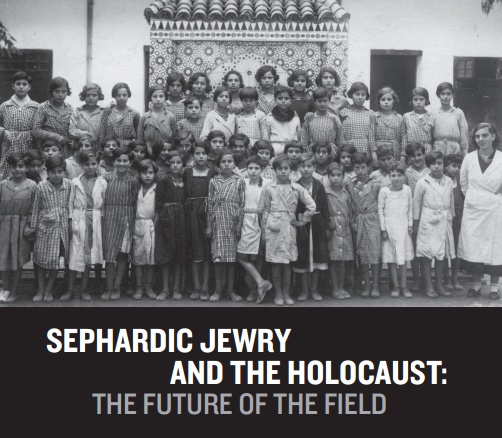
Cover photo: Laurette Cohen (front row, far right) poses with her students at an Alliance Israelite School in Morocco in 1935. US Holocaust Memorial Museum, courtesy of Mathilde Tagger

I was amazed see the photo of my mother, Laurette Cohen nee Moyal, scholl teacher. Thew photo was taken in Meknes, Morocco, in 1937.
Jst to let you know!
The first photo showing the pupils of a classroom and their teacher (right side) was taken in Meknes, Moroco in 1936. The teacher is my late mother, Laurette Cohen nee Moyal.
That photo has nothing to do with the Holocaust.
Shalom,
Mathilde Tagger
Jerusalem
Interesting, Mathilde! One wonders why they used the picture.
Rachel