eSefarad Noticias del Mundo Sefaradi

Keys to unlocking mysteries of Seattle Sephardic history are being handed over to University of Washington professor Devin Naar in the form of books and other printed materials – some of them centuries old, most originating from the old country, all written in Ladino.
The loaned items arrive in ordinary cardboard boxes and unremarkable grocery bags. The contents, though, are true treasures:
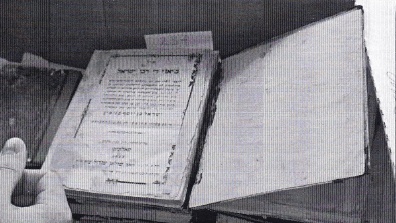
- A guide on good Jewish practices, published in Constantinople in 1742.
- Twelve volumes of Meam Loez (or»From a Foreign Tongue»), a series of 18th and 19th century intellectual commentaries on the Five Books of Moses.
- The script of a play written by Leon Behar that a Ladino theater troupe performed in Seattle in the early 20th century.
- A scrapbook belonging to Albert D. Levy containing clippings of stories he wrote as a reporter for La Vara, the Ladino-language newspaper in New York City.
- A series of letters written by Claire Barkey, a young Jewish woman on the island of Rhodes, to relatives in Seattle that record how she helped orchestrate her family’s escape from the Nazis.
Ladino, also known as Judeo-Spanish, was the language spoken by Sephardic Jews after they were expelled from Spain in 1492.The Ladino dialect spoken in Turkey and Rhodes, which is where Seattle’s first wave of Sephardic immigrants originated, reflects an archaic Castilian Spanish and merges words from Hebrew, Greek and Turkish.
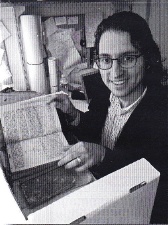
Ladino books and documents pre-dating the 2Oth century are written phonetically using the Hebrew alphabet and therefore read from right to left. Naar is one of few scholars in the U.S. who can read and translate Ladino from the Hebrew characters.
The great grandson of a Sephardic rabbi in Salonika, Greece, Naar grew up in New Jersey but pursued a teaching position in Seattle in order to study – and learn from – the third largest Sephardic community in America. He began his appointment at the UW in 201 1 as an assistant professor in Jewish studies and history.
He got the idea for his Seattle Sephardic Treasures project after participating in an informal Ladino class in Seattle. The students brought him letters in Ladino from parents and grandparents, and asked him to translate them in hopes of piecing together cryptic family histories.
«What if I pursued this? What would turn up?» Naar recalls thinking to himself. «lt turns out, quite a lot.»
Naar set up a booth outside the annual Purim bazaar at Congregation Ezra Bessaroth and later at the September bazaar at Sephardic Bikur Holim Congregation. ln just a few months, he has amassed close to 500 Ladino books and documents, which amounts to the second largest collection of its kind in the U.S. Only Yeshiva University has more.
He plans to have the books and documents catalogued and digitized, creating the first-ever online Ladino library.
It will be modeled after an online library operated by the Yiddish Book Center in Amherst, Mass., that offers 11,000 Yiddish titles for reading or download.
No doubt, more treasures are cloistered in closets and stacked on shelves within the homes of Sephardic Jews in Washington whose parents and grandparents came to the U.S. from the Ottoman Empire. Albert Maimon loaned family treasures to the project as well as a collection of Ladino books from Sephardic Bikur Holim that had been taken off the synagogue’s library shelves and stored in Safeway grocery bags.
«When people pass away and their families close up the houses, they look at all the personal effects and decide what to do with them/’Maimon said. «They might see books in Ladino and donate them to the synagogue. Devin’s project is providing a systematic way to clear out closets and unlock mysteries for our families and our community. It’s exciting to have a scholar with the interest and knowledge that aligns so well with our communal interests.»
 The Sephardic Treasures project, an initiative of the Stroum Jewish Studies Program at the UW, also complements the mission of the Washington State Jewish Historical Society to discover, preserve and educate. Our collection, the Washington State Jewish Archives, stored at the UW contain thousands of photographs, documents, personal papers and oral histories – all donated to us by generous individuals and families so future generations can enjoy and share in our rich and diverse heritage. Books are not included within our archives but the Sephardic Treasures project is opening lines of communication with families who have loaned books to Naar and are interested in preserving other family treasures, such as photos and correspondence, that fallwithin our scope as caretakers.The letters from Claire Barkey, for example, will be transferred permanently to the Washington State Jewish Archives once they have been digitized through the Sephardic Treasures project.
«We are all very excited about the possibilitiesi said Wendi Lyons, WSHJS archivist.
Sadly, Ladino is a language in danger of dying out as native speakers pass away. Naar said he is aware of the moral imperative of his work, although the project is not about linguistics.
«The language tells the story of a civilization and the meaning of that civilizationi he said. «The project is about preserving that history’
For more information on Seattle SephardicTreasures, or if you have a treasure to loan the project, contact Devin Naar at 206-616-6202 or denaar@uw.edu You also may visit: http://jewdub.org/sephardic-studies-initiative.
Fuente: NIZKOR Lets us Remember / Winter 2013 (Newsletter of Washington State Jewish Historical Society).
————————————————
Many thanks to John Holcenberg for sending this article.
————————————————