Mapping the Jewish Communities of the Byzantine Empire – GIS component

byzantine1

The aim of the project is to map the Jewish presence in the Byzantine empire using GIS (Geographical Information Systems).

All information (published and unpublished) about the Jewish communities will be gathered and collated.

The data will be incorporated in a GIS which will be made freely available to the general public on the world-wide-web.

Researchers and members of the public will be able to create maps according to their own specifications.

Chronologically, the project will begin in 650. This is soon after the Arab conquest of Egypt, Palestine and Syria when these regions, with their substantial Jewish populations, were permanently separated from the Byzantine empire. The end-date is fixed by the arrival in the region of large numbers of Jewish immigrants from Spain in 1492.

Geographically, the core areas of Asia Minor, the southern Balkans and the adjacent islands including Crete and Cyprus will be included for the entirety of the period, Byzantine Italy however, will only be covered down to the Norman conquest. Some smaller territories that were only briefly under Byzantine rule may be excluded.
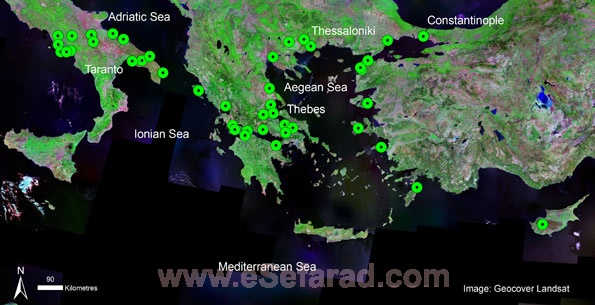
bizantyne2

NEWSFLASH! The project’s Web-GIS is now live and accessible at http://www.byzantinejewry.net
 

Check Also

El profesor asociado de español y lingüística Bryan Kirschen y la profesora asociada de estudios judaicos e historia Dina Danon imparten conjuntamente una clase en la que los estudiantes colaboran con la organización JewishGen para transcribir registros familiares escritos en judeoespañol de Salónica, Grecia (1934-1935). El grupo que aparece en la foto (de izquierda a derecha): Anne-Marie Gabel, estudiante de primer año de Estudios de la Mujer, Género y Sexualidad e Historia; Flora Brill, estudiante de segundo año de Lingüística y Estudios Judaicos; Erin Keating, estudiante de primer año de Lingüística; Adina Steiner, estudiante de segundo año de Antropología y Estudios del Mediterráneo Antiguo; Danon; Kirschen; Marcos Guinazu, estudiante de primer año de Ciencias Políticas; Leila Falkovsky, estudiante de primer año de Biología y Estudios Evolutivos; Aaron Miller, estudiante de primer año de Griego y Latín; y Rafi Josselson, estudiante de primer año de Estudios Judaicos e Historia. Crédito de la imagen: Jonathan Cohen.

La clase del Proyecto Fuente transcribe registros censales de la rara escritura sefardí.

  El conocimiento que tienen los estudiantes del solitreo, una forma manuscrita del ladino, está …

Deja una respuesta

Tu dirección de correo electrónico no será publicada. Los campos obligatorios están marcados con *

Este sitio usa Akismet para reducir el spam. Aprende cómo se procesan los datos de tus comentarios.
