eSefarad Noticias del Mundo Sefaradi

This is the weekly column of David Shasha in eSefarad.
The following article was published in the Sephardic Heritage Udate #614
Jewish, Portuguese, and Perhaps the Richest Woman in the World
By: Aviva Lori
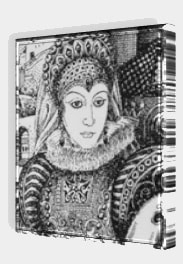 About 10 years ago, while visiting the Museum of Jewish Art and History in Paris, Israeli journalist Naomi Keren noticed an ancient silver medallion that bore the likeness of Dona Gracia Nasi. “I was taken aback,” Keren says. “What I saw contradicted everything I knew about the use of art in connection with portraits in the Jewish world, because of the Second Commandment about making graven images or likenesses.” Two other aspects of the medallion also came as a surprise to Keren: it carried the image of a woman at its center, and the accompanying inscription was in Hebrew.
“I didn’t know Dona Gracia’s life story, but the medallion piqued my curiosity,” Keren recalls. So much so that she spent the next decade delving into the life of the 16th-century Jewish stateswoman and businesswoman, and writing a historical novel about her. In the course of her research, she discovered that portraits were in fact a feature of Jewish art during many periods in the past. Ironically, the portrait on the medallion Keren saw in the museum turned out to be not that of the famous Dona Gracia but of her niece, who had the same name.
“Current research is almost completely certain that the woman on the medallion is not her,” Keren states. “The piece was minted in Italy in 1558, the year of her niece’s marriage, and at a time when Dona Gracia had not been in Italy for five years. Furthermore, the woman in the medallion is young, but in 1558 Dona Gracia was no longer a young woman. According to most evaluations, it is not her.”
Keren’s novel, “La Senora” (in Hebrew), consists of imagined diary entries and letters written by Dona Gracia (1510-1569). The first of these fictional letters was ostensibly sent in 1537 from Lisbon, Dona Gracia’s birthplace. The others are “postmarked” Antwerp, Venice and other scenes of her tempestuous life.
Initially, Keren set out to write a historical study rather than a novel. Before becoming a journalist, she obtained a degree in general history and an M.A. from the Schechter Institute of Jewish Studies. She completed her study of Dona Gracia two years ago, but was unsatisfied with the result.
The manuscript was neither sufficiently academic nor sufficiently literary, she felt. Her first thought was to extend the historical research and turn it into a doctoral thesis. Ultimately, though, in consultation with the literary editor Haim Pesach, she decided to take the opposite track and write Dona Gracia’s life as a work of fiction.
“As we know,” Keren says, “the study of history is always carried out from the present into the past. To know how things happened exactly, researchers need to be on hand in the past, which is of course impossible. We can draw very close to the historical truth − if we assume that it exists − but only up to a certain point. There will always be gaps that need to be filled in.”
From that perspective, she notes, “I think I did the maximum. I tried to research as thoroughly as possible the period in which Dona Gracia lived: the utensils people used, what kind of lavatories they used (or didn’t use), what the fabrics they wore felt like on the body. I examined things that are perceived as extremely trivial, but wide gaps still remained. The research was unable to illuminate what she felt in any particular period of her life, for example; or what she thought about, or what bothered her.”
For many years, the medallion she saw in the museum was indeed thought to be a representation of Dona Gracia. But there is no visual documentation of her, says Keren. “There is no painting, definitely no picture. In fact, there is no direct testimony relating to her. There are no diaries, no letters, no text she herself wrote. There is no object that is associated directly with her. Her name appears only in external documents, written by the authorities in the countries in which she lived and was active.”
It was not just Dona Gracia’s eventful life that drew Keren. In retrospect, after that decade of research “and almost living in her company,” she realized that her attraction to the 16th-century woman was generated in part by her own personal biography. “Strong women and complex identities were elements in the milieu in which I grew up,” she says.
Her mother, Inger, was born in Denmark to an upper middle class Christian family. She studied social work in Edinburgh and did her internship in London under Anna Freud, the daughter of the founder of psychoanalysis. There she encountered Jewish orphans from World War II and decided to help.
In the mid-1950s, Keren relates, “Inger met with the Israeli ambassador to Denmark to ask how she could be of assistance. He suggested that she go to Israel and help treat elderly Holocaust survivors in Jerusalem. And that is just what she did. She went to Jerusalem and was employed as a psychiatric social worker. She met my father, Shlomo Borer, a writer and journalist, at a party, and they were married three months later.”
Her mother “never really fully belonged here,” Keren says. “She possessed a complex personality made up of several identities that sometimes seemed contradictory and sometimes could be peacefully integrated. Naturally, something of this passed to me as well. I think that writing about Dona Gracia helped me come to terms with that complexity − hers and mine − more easily.”
Keren, 50, was born in Tel Aviv and grew up in the city’s solidly middle class Old North section. “As an only child, I was always certain that I had a hidden brother or sister,” she recalls. “At one stage I was absolutely sure of it and I poked around in my parents’ things looking for information about them. “Alternatively, it also crossed my mind that I might be an adopted child. Later, I discovered that this is often the case with only children. I met a few others, and they had gone through the same stage.
“My mother died four years ago,” she continues, “and I took home many crates containing her effects. Some of them are still sealed. I am now slowly starting to open them. There is also a language barrier in connection with what she left behind, which is why I am now learning Danish. Regrettably, my mother thought that if I were to learn two languages as a child, I would connect less to the place I lived in and would not have a mother tongue, in the sense of ties and roots. So she spoke only Hebrew to me, and with my father also English. I only heard a great deal of Danish in the house when my grandparents from Denmark came to visit for a month every year when I was a girl.”
Keren did her military service as an announcer on Army Radio for three years. There she met Naftali, who was a civilian technician at the station, and married him when she was 20.
Following her service she enrolled in TelAvivUniversity to study history, and had dreams of an academic career. But her background and experience at Army Radio led her to audition as a continuity announcer for Israel Television, which at the time operated the only channel in the country. “In the early 1980s they were thinking of returning to that format [an announcer between programs to tell viewers what was coming up next] and they held screen tests for the job. From the auditions they always took someone for a different job, such as to host a music program or join the sports unit. And every year I went home to get on with my life.
—————————————————————————————————————-
 by David Shasha to eSefarad.
Copyright David Shasha & eSefarad all rights reserved
Copyright David Shasha & eSefarad todos los derechos reservados.
David Shasha is the founder and director of the Center for Sephardic Heritage in Brooklyn, New York designed to raise awareness of the history and culture of Arab Jews. He publishes the Sephardic Heritage Update, a weekly e-mail newsletter available on Google Groups. He has written for publications such as the Huffington Post, Tikkun magazine, The Progressive Christian, and The American Muslim. You can contact him at david.shasha.shu@gmail.com