eSefarad Noticias del Mundo Sefaradi

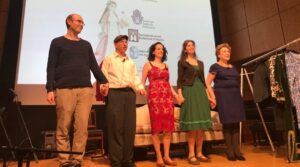
Actors onstage performing in the Ladino play «Scenes from Forsyth Street» by David Altabe during New York Ladino Day in January 2020. (Courtesy Bryan Kirschen
The sixth annual New York Ladino Day — which aims to celebrate and elevate Ladino culture in New York and throughout the world — will take place this Sunday at the Center for Jewish History in Manhattan.
For the first time since the pandemic, the program will be conducted in person, though a livestream option is also available. This year’s theme is “Kontar i Kantar” — “Storytelling and Singing” — and will include a performance from Tony- and Grammy-nominated Broadway singer Shoshana Bean and a conversation with Michael Frank, author of “One Hundred Saturdays: Stella Levi and the Search for a Lost World,” as well as additional music-oriented speakers and performances.
“Music is certainly one of the domains in which the language is doing well and generating new interest and new music,” said Bryan Kirschen, a professor of Hispanic Linguistics at Binghamton University and one of the event’s organizers. (Kirschen was one of the New York Jewish Week’s “36 Under 36” in 2017.)
Ladino, or Judeo-Spanish refers to the language spoken by Jews who trace their origins to the Iberian Peninsula. After the Jews’ expulsion in 1492, they preserved elements of their language while also incorporating new linguistic features and vocabulary into it as they settled throughout the Ottoman Empire — Turkey, North Africa and the Balkans. Today, the estimated number of Ladino speakers around the world — mostly Sephardic Jews — ranges between 60,000 to 300,000, from fluent speakers to descendants who are familiar with some words.
Sephardic Jews were the first Jewish immigrants in New York, founding Congregation Shearith Israel in 1654, the oldest Jewish congregation in the United States. (It’s still in operation today at 2 West 70th St., where it has been since 1897.) Sephardic Jews remained the only active Jewish community in New York until the wave of German Jewish immigration in the early 19th century, followed by the mass immigration of Eastern European Jews that began at the tail-end of the 19th century.
Soon enough, Ashkenazi Jews quickly outnumbered New York’s Sephardic community, though Sephardic and Ladino culture continues to thrive today. Today, the main hubs for Sephardic and Ladino culture and education are the American Sephardi Federation and the Sephardic Jewish Brotherhood of America, with a range of programming also happening at synagogues like the Kehila Kedosha Janina Synagogue and Museum, The Sephardic Jewish Center of Forest Hills and the Sephardic Jewish Center of Canarsie.
Ladino, said Kirschen, remains “a very living, in some ways thriving language, interestingly enough, particularly since the pandemic.”
Fuente: nyjewishweek.org