eSefarad Noticias del Mundo Sefaradi

Exiled Spanish and Portuguese Jews who had fled to Italy translated Hebrew bible into their common language.
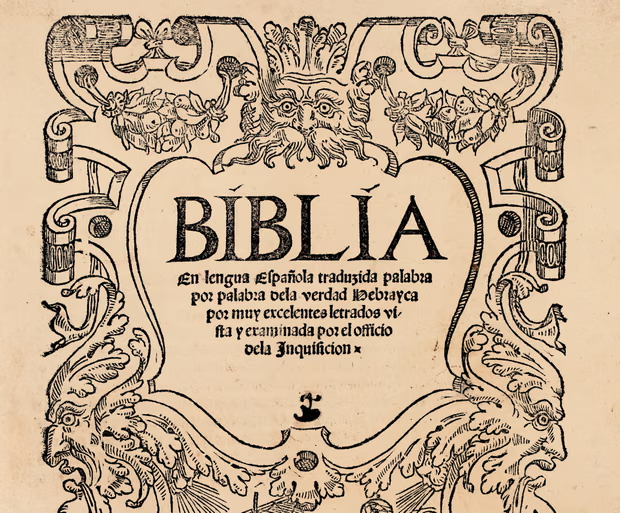
In 1553, a community of exiled Spanish and Portuguese Jews who had found refuge and patronage in the northern Italian city of Ferrara did something that would have been unthinkable, and very possibly fatal, in their former homelands.
They printed their own Hebrew bible in Spanish.
The Ferrara bible, as the volume came to be known, was needed for reasons both practical and symbolic. A large number of the Sephardic Jews living in Ferrara had ostensibly converted to Roman Catholicism in an attempt to avoid expulsion by King Ferdinand and Queen Isabella in 1492. But many of the converts, or conversos, had tried to keep their ancestral faith alive by practising it in secret. Despite their best efforts, however, time, displacement and the prohibition on Judaism soon eroded their knowledge.
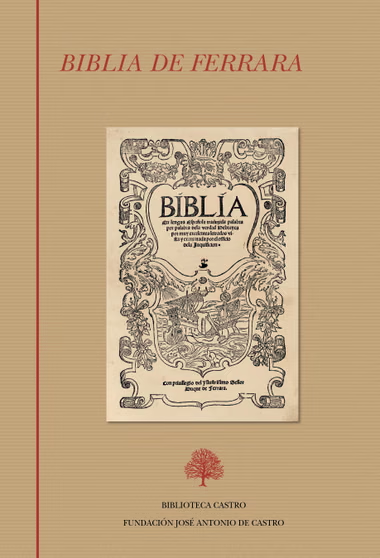
“The Ferrara community was formed not so much by those expelled in 1492, but primarily by Portuguese and Spanish converts who had remained crypto-Jews, that is, they had secretly maintained Jewish religious practice and preservation within their families in Spain or Portugal, passing it down from parents to children,” said Paloma Díaz-Mas, a Spanish writer and scholar who has written an introduction to a new edition of the Ferrara bible.
“But of course, they didn’t have synagogues, they didn’t have rabbis, they didn’t have Hebrew books because they were persecuted. And possessing a book in Hebrew could lead to an inquisitorial trial.”
But once under the protection of Ercole II d’Este, the duke of Ferrara – the son of Lucrezia Borgia and the grandson of Pope Alexander VI – the community could set about relearning its lost rituals. The only problem was that few of the Jews in Ferrara could speak or read Hebrew, which is how the Ferrara bible came to be the first complete, printed edition of the entire Hebrew bible in their common language: Spanish.
Others in the Sephardic Jewish diaspora were also trying to reclaim their faith, said Díaz-Mas. “They wanted to preserve Judaism, but they knew less and less about it. When these people were able to found Jewish communities in other countries – in Italy or in Amsterdam – the problem was that they didn’t know enough about Judaism and they didn’t have access to Hebrew texts because they didn’t know Hebrew. Communities like the one in Amsterdam, for example, imported rabbis from the Ottoman empire or from north Africa to serve as their spiritual guides.”
Although the creators of the Ferrara bible prided themselves on producing “a bible in the Spanish language translated, word-for-word, from the true Hebrew by excellent scholars”, they also acknowledged that the literal translation, which follows Hebrew syntax, “may seem rough and strange and very different to the polished words we employ these days”.
Fuente: theguardian.com