eSefarad Noticias del Mundo Sefaradi


Guy Ben-Aharon has been introducing important Israeli writers like Savyon Liebrecht (“Apples in the Desert”) and Gilad Evron (“Ulysses on Bottles”) to Hub students and general audiences in two-week cultural residencies. Now the Tel Aviv-born artistic director’s Israeli Stage is hosting its first Sephardic playwright-in-residence: Hanna Azoulay Hasfari.
Recently, the Israeli award-winner (two Israeli Film Academy best actress prizes, among others), who has been giving “Identity through Art” lectures at Emerson, Wellesley and Northeastern, spoke to The Jewish Advocate about her Moroccan ancestry and her new play, “Dina.”
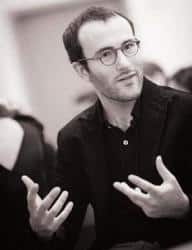
Tel Aviv native Ben-Aharon, who is directing the family drama’s world premiere staged reading at Brandeis (April 1) and Boston University (April 3), commented on the award-winning playwright’s residency as a cultural bridge and the significance of their collaboration.
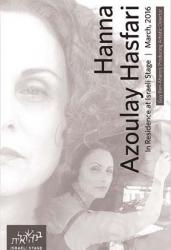
Free and open to the public; israelistage.comAzoulay Hasfari is the sole sabra in her lineage. “All the other women in my family, which includes my mother and three sisters,” she said, “were born in Morocco.”
“I was raised in two cultures,” she said. “The one from home, which is Moroccan and traditional, and the other from the outside, which is Western and democratic.”
Azoulay Hasfari is critical of both cultures’ attitude toward women. “It [her mixed response] is seen in every one of my works,” she said. “Both attitudes: a lot of respect combined with criticism.”
This combination is very evident in “Dina.” At the start of this moving text, the middle-aged title heroine is looking forward to the Passover seder. At the same time, exchanges with her three very different brothers – secular Shimon and Yehuda and very religious Binyamin – reflect a deep-seated feeling that she has not done enough with her life.
Breathing hazardous material at work for three decades, yet refusing to wear a protective mask, Dina learns she has terminal lung cancer. Trying to make as many electronic plates for the IDF’s new tanks as possible – the mask would have reduced her production, she explains – she maintains, “Soldiers’ lives depended on us.”
Eventually, she has a camerawoman record her warm feeling towards her brothers, her lingering regrets about not doing more as a painter, a ‘fictitious marriage’ into which she was rushed at age 17 and her ongoing desire to see the son she had to give up.
Jules Becker is The Advocate’s theater critic.The playwright’s observations about Sephardic society andIsraeli diversity brought many of these points to mind. “The Sephardic society,” Azoulay Hasfari said, “is pluralistic. The Ashkenazi Zionist movement tore apart the Sephardic family, spreading them into every aspect of modern Israeli society: traditional family settings, religious families, secular society, factory workers, agricultural workers, artists, authors – creating a full rainbow of people with Sephardic background.

“Sometimes the diversity is bad because it causes a balagan [a mess] in our identity,” continued. “Sometimes the diversity is good, because it’s enriching for the Sephardim and the society around them.”
Calling the drama’s camerawoman “the eyes of the playwright,” Azoulay Hasfari saw her symbolizing “the morality of the society” and filling “the place of a plea of guilty to the things that we see and ignore in our lives.”
As one of the founders of “The Democratic Sephardic Rainbow Coalition,” she has never ignored the need “to fight for the representation of Mizrachim (Easterners) in Israeli society.” The coalition, she said, “offered a social and diverse alternative against the Ashkenazic hegemony.” Still around today, she said the coalition “pushes for a society that is democratic, diverse, just and harmonious.”
Ben-Aharon saw Azoulay Hasfari’s residency as a special chance for a mutual sharing of such diversity. “Hanna’s residency is an incredible opportunity for Boston: it is a unique way for Boston to connect to one of Israel’s most brilliant minds,” he said.
“We went from (practically) being strangers to spending every moment of the day together,” he said. Ben-Aharon marveled at the way he got “to explore the way [Hanna and his cast], the way they act [actress Hanna advising] and the way they react. As a director, there’s nothing like it.”
The staged reading cast includes some of Boston’s finest actors: Maureen Keiller as Dina, Jeremiah Kissel as Shimon, Dale Place as Binyamin, Patrick Shea as Yehuda and Shanae Burch as the camerawoman.
Source: JTA