eSefarad Noticias del Mundo Sefaradi

According to the United Nations Educational, Scientific, and Cultural Organization (UNESCO), more than 200 languages have become extinct over the past three generations. Now, a UW Jewish studies professor is preserving and digitizing Judaeo-Spanish, or Ladino, artifacts before the severely endangered language is added to that tally.
Devin Naar, an assistant professor of history and Jewish studies, started the Seattle Sephardic Treasures project in an effort to gather Ladino source materials in one place. Ladino, which is a combination of medieval Spanish traditionally written in Hebrew letters and spoken by Jews who lived in the Ottoman Empire, currently has anywhere from 100,000 to 200,000 speakers.

Naar said there were several starting points that made the project a natural fit for him, including Seattle’s large Sephardic population (third largest in the United States), the resources at the UW, such as the Stroum Jewish Studies Program that has had students researching and writing on the topic since the 1930s, and Naar’s own familial background.
“My grandfather was born in Salonika, a city that was home to the largest Ladino-speaking community in the world a century ago. Similar to many other communities, Salonika was decimated by the Holocaust,” Naar said. “Like many American descendants of Ladino-speaking Jews my generation, I heard certain words, expressions and prayers growing up from my grandparents’ generation, but the language was not fully transmitted to me.”

Members of the local Sephardic community have contributed everything from family documents and letters to books from past generations, and Naar has taken advantage of established Sephardic institutions to spread the word about the project.
At an annual Purim Bazaar at Congregation Ezra Bessaroth in Seward Park in March, Naar and his colleagues solicited Ladino items and distributed flyers about the project. Since then, Naar has received contributions from dozens of individuals in the Seattle area.
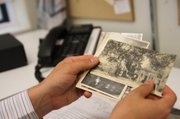
“We’ve received hundreds of family letters, including extensive correspondence between Rhodes and Seattle during the 1920s and 1930s; postcards, and family photos, and immigration documents; dozens of rare books published in the 19th and early 20th centuries in cities of the former Ottoman Empire, such as Salonika, Istanbul, and Izmir,” Naar said. “We’ve even received a fascinating set of notebooks penned by Leon Behar, an Istanbul native who directed Ladino theater productions here in Seattle in the 1920s and 30s.”
While it has only scratched the surface thus far, community members have high hopes for the project.
“Just think for a moment of all the authors of the past several hundred years, who wrote manuscripts, that they would have dreamed or imagined that their works would be made accessible to a world-wide audience,” said Isaac Azose, the cantor at Congregation Ezra Bessaroth. “In the same way, making these ‘treasures’ accessible to the descendants of Ladino-speaking Sephardic Jews will help them to know who they are and where they came from.”
Moving forward, big goals have been set for the project. Noam Pianko, a professor in and chair of the Jewish studies program, said the project is a way to both bridge communities and engage students.
“Over the next year or two, I see this project as a great way to explore new partnerships between the Seattle Jewish community and the University of Washington,” said Pianko. “This program is an example of engaged scholarship that enriches the community and the field of Jewish studies at the same time.”
Naar, one of the few scholars in the United States conducting research on the history and culture of Ladino-speaking Jews, is also excited for the future of this work.
He said he hopes to create the first online Ladino Resource Center and make the UW a center for the study, preservation, and transmission of the Sephardic culture.
“Perhaps the UW could even become the first and only university in the United States to teach Ladino in the traditional Hebrew scripts, and breathe some new life into this endangered language,” Naar said. “The goal is to create not only a center for the study of the Sephardic Jewish experience by students, faculty, and researchers, but also a multifaceted resource center for Sephardic Jews in the community and worldwide.”
By Joe Veyera
Fuente: dailyuw.com