eSefarad Noticias del Mundo Sefaradi

This archaeological excavation site in the Castle premises has confirmed the existence of different cultures that have settled in this area. This enclave has been proved to have been of great importance during these last 4000 years, because of the control over the main routes between the valley and the different settlements in the region.
The settlement of the Jewish community in Lorca may be due to the success in retaking and repopulating the Iberian Peninsula from the Muslims throughout the second half of the 13th century and the 14th century, since they were part of the repopulation contingents who arrived to this area.
The location of the Jewish Quarters, characterised by the intricate layout of their streets, might differ from one city to another, although during the Reconquest process they were usually placed next to a castle or any other fortified building, but always separated from the rest of the city. The fact of being inside the fortified precincts, enclosed by fences or walls, enabled Jews to live under their own rules, in accordance with their customs and religious beliefs. Thus, the so-named Aljama was constituted, formed by those Jews who belonged to the community, even if they lived out of their neighbourhood.
It was a self-governing community living under Spanish Christian rule.
The synagogue dates back to the first half of the l5th century, as proved by the materials found in the different stratigraphic contexts in that area. By the time, a great urban expansion occurred due to a population growth, so the construction of a remarkable building was required in order to meet the community needs.
Even if the architectural shapes of synagogues vary greatly, the most common floor plan for those in the Diaspora corresponds to a prayer room in a basilica or a minor hall, with some adjacent rooms or spaces for a communal or domestic use. Thus, the Synagogue and the building named House VII in Lorca present a similar scheme, because of their spatial relation apart from the rest of the houses in the Jewry.
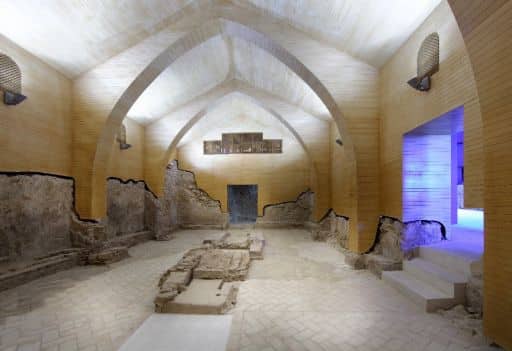 The excavated area presents an urban layout where the synagogue is the central point of the Jewry. Both constructions (the synagogue and the house VII) lie in the same terraced area, set partially into a small hill inside the fortress. They include a section of a wall from the Almohad period, which is fitted into the Islamic terraced area on this side of the Castle. Most of the fortified wall is broken for building purposes, just preserving the most south-eastern part of the wall, where there is a tower. The house VII also includes a section of this wall on its south-western side.
The courtyard is the central point between the two buildings, a gathering place, meeting the community political, social or ritual needs.
Some clearly-defined spaces in the house VII consist of a series of elements, mainly oven structures, which give evidence of the service function of these rooms. There were also a series of passageways which enabled an inner way between the different spaces, and to the synagogue through the patio. The street access to the building is located in the north-eastern wall. In this sense, the courtyard becomes an essential piece in the building, in order to meet the ritual and social needs of the community.
Fuente: murcia-exposed.co.uk